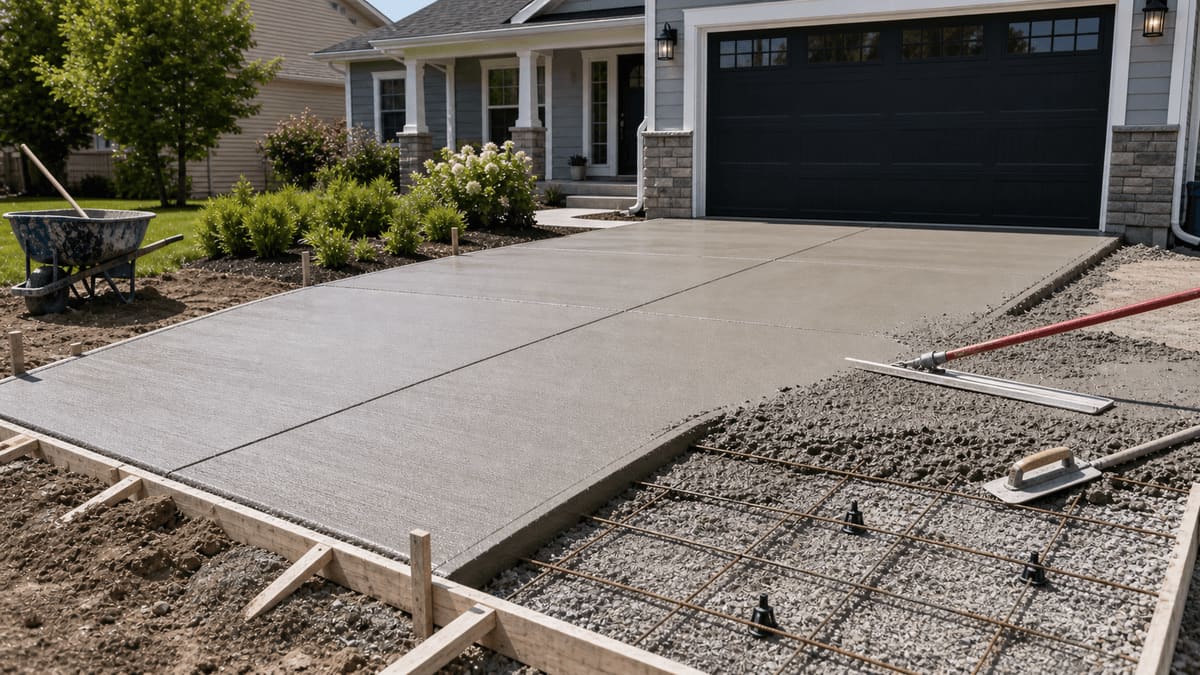
Concrete driveway cost by size
A standard 4-inch broom-finished concrete driveway runs $13–$26 per square foot installed:
| Driveway | Size | Installed cost |
|---|
| Single-car | 20 × 10 (200 sq ft) | $3,300 – $5,200 |
| Single + walk | ~400 sq ft | $6,000 – $9,600 |
| Double-wide | 40 × 20 (800 sq ft) | $10,800 – $17,400 |
Decorative finishes add to those figures — stamped concrete alone adds $6–$10 per sq ft.
Base and reinforcement: why driveways crack
A concrete driveway fails from what's under and inside it. The base — 4 inches of compacted gravel ($1.10–$1.85/sq ft), or 6 inches ($1.55–$2.65) over clay or for heavy vehicles — gives the slab uniform support so it doesn't settle and crack. Reinforcement ties it together: fiber admixture ($0.30–$0.55/sq ft) for light duty, welded wire mesh ($0.55–$0.95), or a rebar grid ($0.65–$1.10) for anything carrying vehicle weight. Add proper control joints, and a 4-inch slab (thicker for RVs or trucks) lasts decades. Skimping the base is the number-one reason a new driveway cracks in its first few winters.
FAQ
How much does a concrete driveway cost in 2026?
A standard 4-inch broom-finished concrete driveway runs $13-$26 per square foot installed. A 20x10 single-car costs $3,300-$5,200; a 40x20 double-wide $10,800-$17,400. Stamped decorative finishes add $6-$10 per sq ft.
Concrete vs asphalt driveway?
Concrete is 30-50% more expensive upfront but lasts 30-50 years and needs almost no maintenance. Asphalt is cheaper, faster to install, more forgiving in cold climates, but needs sealcoating every 2-3 years and lasts 20-30 years.
Do I need a permit for a concrete driveway?
Most jurisdictions require a permit for new driveways or expansions, especially where the driveway connects to a public street (curb cut). Permits run $100-$250. Replacing in-kind sometimes does not need a permit.
How much does a stamped concrete driveway cost?
Stamped concrete runs about $21-$34 per sq ft installed - a plain 4-inch driveway ($13-$26) plus a stamped-finish premium of $6-$10. An 800 sq ft double-wide driveway in stamped concrete is roughly $16,600-$27,600.
How thick should a concrete driveway be?
Four inches is standard for cars over a compacted gravel base. Go to 5-6 inches with a rebar grid for RVs, trucks, or trailers - the extra thickness and reinforcement prevent cracking under heavier loads.
Do I need rebar in a concrete driveway?
For a driveway carrying vehicles, yes - a rebar grid ($0.65-$1.10 per sq ft) ties the slab together far better than wire mesh alone. Fiber-mix admixture is fine for light-duty flatwork but not a substitute under vehicle loads.
More questions
Concrete vs asphalt — which lasts longer?
Concrete lasts 30-50 years vs asphalt 20-30. Concrete is roughly 30-50% more upfront but needs almost no maintenance; asphalt needs sealcoating every 2-3 years.
How long before I can drive on it?
Foot traffic in 24-48 hours, light vehicles in 7 days, heavy vehicles or RVs in 28 days. Cure properly with curing compound or wet burlap to avoid surface cracking.
Can I pour over an old asphalt driveway?
No. Asphalt flexes and concrete cracks; the bond fails. Always demo the old surface and start with proper base.
Stamped concrete vs pavers?
Stamped is one continuous slab, lower install cost but cracks show. Pavers are individual units, $5-$10/sf more, but cracks don't propagate and individual units can be replaced.
Do I need expansion joints?
Yes — saw-cut control joints every 8-12 ft within 24 hours of pour. Without joints the slab cracks randomly.