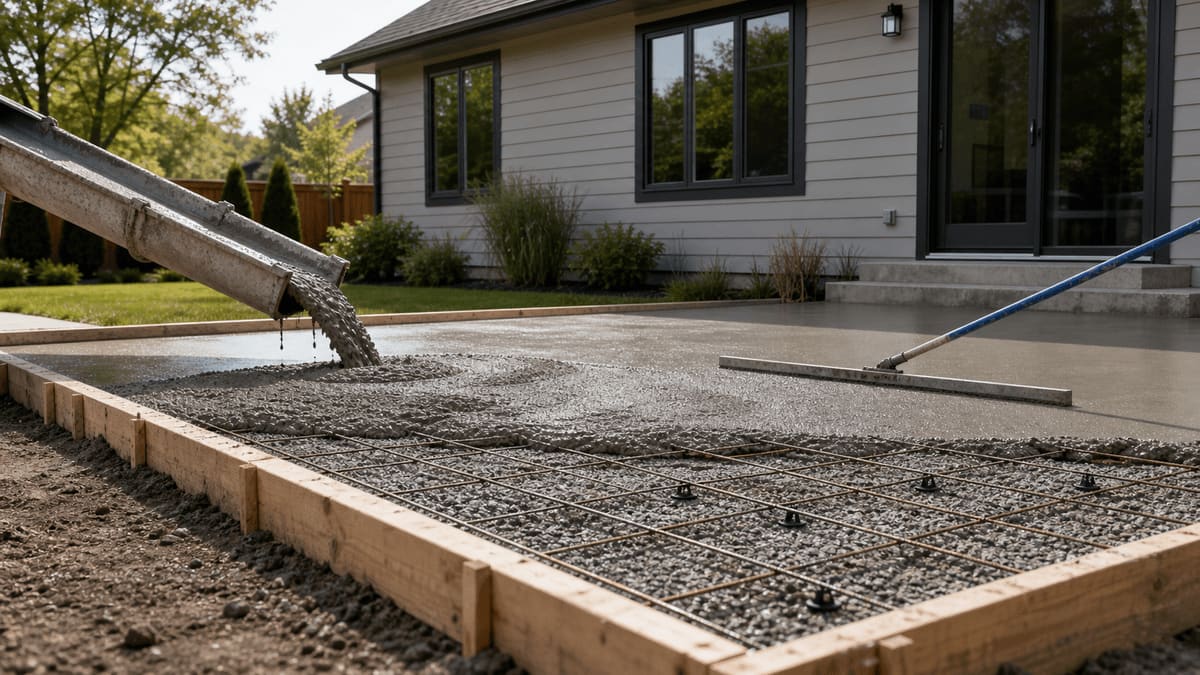
How much does a concrete slab cost in 2026?
A standard 4-inch residential concrete slab costs $6 to $12 per square foot installed in most U.S. markets in 2026, with the national average around $8 per square foot for basic flatwork. Complete projects price higher: the installed ranges below carry base, reinforcement, thicker sections, and the fixed costs that weigh heaviest on small pours. These are planning ranges — your local quote may sit anywhere within or slightly outside this band depending on regional labor, season, and quarry distance.
| Project | Typical size | Installed cost (range) |
|---|
| Patio | 10×10 (100 sq ft) | $2,100 – $3,000 |
| Shed pad | 12×16 (192 sq ft) | $3,500 – $5,200 |
| Garage slab | 20×20 (400 sq ft) | $5,100 – $8,300 |
| Driveway | 16×40 (640 sq ft) | $8,900 – $14,400 |
| Shop slab | 30×40 (1,200 sq ft) | $20,200 – $32,200 |
What the per-square-foot price includes
The $6–$12 installed range covers the full assembly, and knowing the layers helps you compare bids line by line:
- Base — 4 in of compacted gravel under the slab. Skipping it is the #1 cause of early cracking and heave.
- Forms and layout — lumber forms, square-up, and elevation set for drainage slope.
- Reinforcement — wire mesh ($0.20–$0.50/sq ft) for patios and walks; rebar grid ($0.40–$1/sq ft) for anything that carries vehicles.
- Concrete — the mix itself, typically 3,000–4,000 PSI for residential flatwork, 4 in thick for patios and 5–6 in where vehicles park.
- Finishing — screed, float, broom or trowel finish, and control joints sawn or tooled on a 8–12 ft grid so the slab cracks where it is told to.
- Curing — compound or wet cure; concrete reaches working strength over days, not hours.
Decorative work — stamping, integral color, exposed aggregate, polishing — is priced on top of this base assembly and can add 50–100% to the flatwork price depending on pattern complexity. Get decorative finishes quoted as a separate line so you can see the premium.
DIY pour or hire a crew?
Concrete is unforgiving of slow hands: once the truck starts discharging, a 400 sq ft pour gives a two-person crew about an hour of workable time to screed, float, edge, and joint. Small pads — a grill pad, a 4x4 stoop, a mower ramp — are honest DIY projects with bagged mix. A patio, driveway, or garage slab is crew work, and the line items you'd save (labor) are smaller than the cost of a failed pour that has to be broken out and hauled away.
If you want to cut cost with sweat instead of risk: do the excavation, base compaction, and forming yourself to your contractor's spec, then let their crew handle mix day. Many flatwork contractors will price that split.
Frequently asked questions
How much does a concrete slab cost in 2026?
A standard 4-inch concrete slab runs $6-$12 per square foot installed in 2026 for the flatwork itself; complete projects price higher per foot once base, reinforcement, and fixed costs are counted, especially on small pours. A 10x10 ft patio costs roughly $2,100-$3,000, a 20x20 ft slab $5,100-$8,300, and a 24x24 ft garage slab $7,900-$12,700. Thicker slabs (5-6 in for driveways) and decorative finishes (stamped, colored, polished) push price higher.
How thick should a concrete slab be?
Patios and walkways: 4 in. Driveways and garage floors: 4-5 in (5-6 in if heavy vehicles). Foundation slabs: 4-6 in with rebar. Always include a 4 in compacted gravel base under the slab.
Do I need rebar or wire mesh in a concrete slab?
Wire mesh ($0.20-$0.50/sf) is fine for patios and walkways. Driveways, garages, and any slab supporting weight should use rebar in a grid ($0.40-$1/sf). Fiber-reinforced mixes can substitute for mesh in some thin slabs.
How do I calculate cubic yards of concrete?
Multiply length (ft) × width (ft) × thickness (ft, divide inches by 12). Divide by 27 for cubic yards. Add 10% waste.
How much does a 30x40 concrete slab cost?
A 30x40 (1,200 sq ft) shop or garage slab runs $20,200-$32,200 installed. Larger slabs price above the simple 4-inch $6-$12 per sq ft math because shop use calls for 5-6 inch thickness, rebar grids, higher-PSI mix, and often thickened edges for future walls.
How long before you can drive on a new concrete slab?
Keep foot traffic off for 24-48 hours, passenger vehicles off for about 7 days, and heavy vehicles off for 28 days, when standard mixes reach design strength. Cold weather stretches every one of those numbers - curing is chemistry, and the chemistry slows below about 50 F.
Is a concrete driveway better than asphalt?
Concrete costs more upfront but lasts 30-40 years with minimal upkeep; asphalt is cheaper to install but needs sealcoating every few years and resurfacing sooner. In hot climates concrete resists rutting; in extreme freeze-thaw regions asphalt tolerates movement better. Compare both with our asphalt driveway calculator.