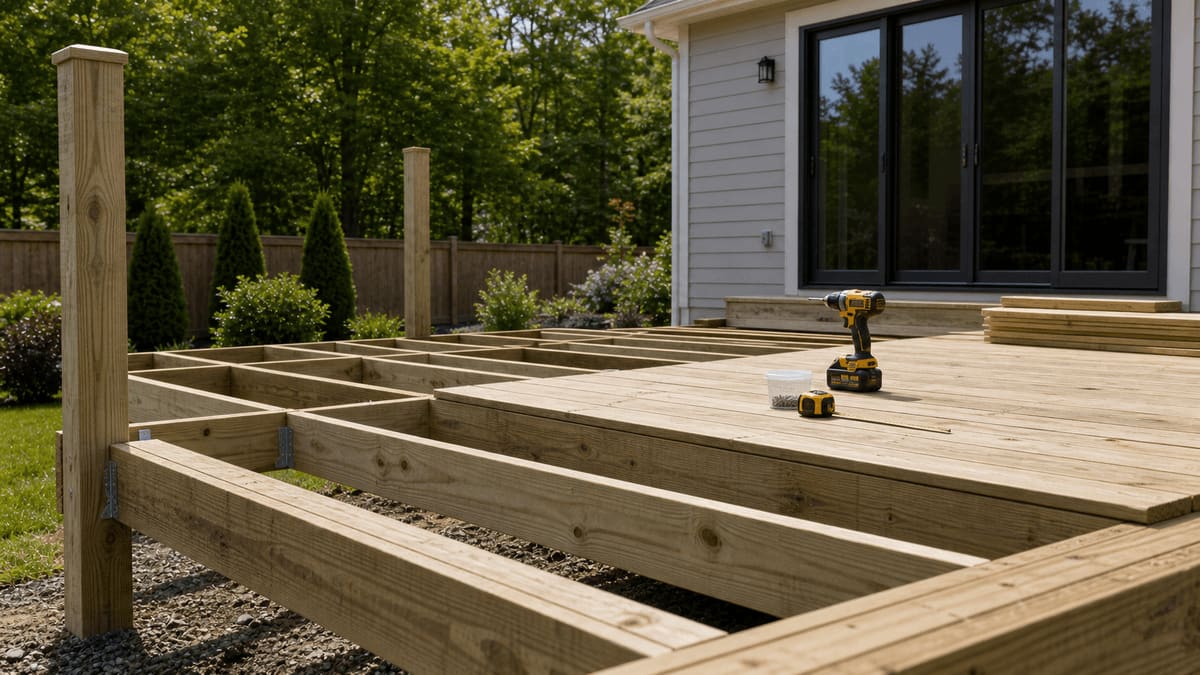
How much does it cost to build a deck in 2026?
A standard residential deck costs $35 to $80 per square foot installed in 2026, including substructure, decking, railing, stairs, and labor. At a fixed deck size, material choice is the biggest swing — pressure-treated lumber sits at the low end, while premium composite and PVC sit at the high end. Across the full range of inputs, though, the deck’s dimensions move the total further than the board you pick; see what drives project costs.
| Project | Size | PT installed | Composite installed |
|---|
| Compact (8×10) | 80 sf | $2,900 – $4,900 | $3,200 – $6,400 |
| Starter (10×12) | 120 sf | $4,200 – $7,100 | $5,000 – $9,600 |
| Small (12×12) | 144 sf | $5,600 – $9,500 | $7,100 – $12,500 |
| Family (12×16) | 192 sf | $9,000 – $15,400 | $11,200 – $20,000 |
| Mid-size (14×20) | 280 sf | $12,300 – $21,000 | $15,000 – $27,500 |
| Large (16×20) | 320 sf | $13,800 – $23,400 | $17,500 – $30,500 |
| Premium (20×24) | 480 sf | $20,000 – $33,500 | $25,000 – $43,500 |
What drives deck cost
- Decking material — pressure-treated boards at $4-$8/sf vs hardwood at $12-$22/sf is a 3-4x range.
- Deck height — taller decks need longer posts, more bracing and footings sized by the design (their depth follows local frost depth and soil). Model codes require a guard where the walking surface is more than 30 in above grade; this planner prices a railing from 30 in up, the conservative side of that line.
- Railing type — wood at $20-$30/lf and composite at $25-$60/lf vs glass at $150-$600/lf is a 10x range.
- Stairs — $150-$350 per step. A 36 in deck needs ~5 steps; a 60 in deck needs ~8.
- Substructure — $8-$18/sf added; complex shapes and steel framing run higher.
- Permit — $50-$300 typical; large or engineered decks $300-$800.
- Region — California and New York labor run 30-35% above national average.
Choosing the right decking material
Pressure-treated lumber (PT)
$4-$8/sf material; $25-$50/sf installed. Cheapest, easiest to find, lasts 15-20 years with regular sealing or staining (typically every 1-3 years, depending on sun, weather and product). The default choice for most homeowners. Boards may warp, crack, or splinter over time.
Cedar
$6-$12/sf material; $30-$47/sf installed. Naturally rot-resistant and insect-repellent. Ages to a silver-gray; needs sealing if you want to keep the warm tone. Lasts 20-30 years.
Composite (Trex Enhance, TimberTech Edge)
$5-$9/sf material; $30-$60/sf installed. Capped composite (wood fiber + plastic with a polymer shell). 25-year warranty typical. No sealing or staining; just rinse.
Composite premium (Trex Transcend, TimberTech Pro)
$8-$13/sf material; $50-$80/sf installed. Higher-grain capped composite with multi-tone coloring. 30-50 year warranty. Looks closer to real wood than basic composite.
PVC (AZEK / TimberTech AZEK)
$9-$13/sf material; $60-$80/sf installed. All-PVC boards (no wood at all). Lightest weight, fully waterproof, longest lifespan. No staining or rot. The most expensive mainstream option.
Hardwood (ipe, mahogany, garapa)
$12-$22/sf material; $40-$70/sf installed. Tropical hardwoods with 50+ year lifespans. Beautiful grain. Needs annual oiling to keep color; otherwise grays. Extremely heavy and hard on tools.
Deck design fundamentals
Sizing
- 10x12 (120 sf) — small bistro / fire pit area for two.
- 12x16 (192 sf) — the most popular family size; fits a 6-person dining table plus a small seating area.
- 14x20 (280 sf) — comfortable dining + lounge zones.
- 16x20+ (320 sf+) — outdoor kitchen or hot tub possible.
Height
Most decks attach to a sliding door or doorway, putting them 12-36 in above grade. The IRC requires a guard where the walking surface is more than 30 in above grade, measured within 36 in horizontally of the open edge — more than 30 in, not 30 in exactly, and the measurement is taken to the grade below rather than to the next step down. A residential guard is 36 in tall (42 in commercial). This planner treats 30 in as the trigger, which is the conservative side of the model code; your adopted local code and its amendments are what actually govern. Well below the trigger, a guard is optional — many homeowners skip it for a more open look.
Stairs
Stairs are computed by deck height: at 7.5 in per riser, a 36 in deck needs 5 risers, a 60 in deck needs 8. The IRC max riser is 7.75 in, min tread depth is 10 in. Each step adds $150-$350 to the project. Tall decks (60 in+) often add a landing partway down.
Footings
Concrete pier footings 30-36 in deep below frost line, 12 in diameter, are standard. In rocky soil or on slopes, helical-pier footings or stepped concrete piers add cost. Most decks need a footing every 6-8 ft along beams.
Deck replacement cost
Replacing an existing deck costs more than the boards alone because you pay to tear out and haul away the old structure first. Plan on $40 to $75 per square foot for a full replacement — a bit higher than a new build at the same material grade, because demolition, disposal, and any rotted-ledger or framing repair stack on top.
- Demolition & disposal — tearing out and dumping the old deck adds roughly $5-$15 per square foot, depending on size, height, and dump fees.
- Boards-only (resurface) — if the substructure is sound, replacing just the decking and railing on the existing frame runs $20-$45 per square foot and is the cheapest way to refresh a deck.
- Full rebuild — if joists, beams, posts, or footings are rotted or out of code, budget for a complete teardown and rebuild at new-construction rates plus demolition.
To model a replacement here, run the calculator at your size and material, then add a demolition allowance of roughly $5-$15 per square foot for tear-out and disposal. A structural engineer or contractor should confirm whether your existing framing can be reused or must be replaced.
Frequently asked questions
How much does it cost to build a deck in 2026?
A standard residential deck costs $35 to $80 per square foot installed in 2026, including substructure, decking, railing, stairs, and labor. A 12x16 PT deck runs $9,000 to $15,400. A 14x20 composite deck runs $15,000 to $27,500.
Is composite or pressure-treated decking cheaper?
Pressure-treated is cheaper upfront ($25-$50/sf installed vs $30-$80/sf for composite), but composite eliminates yearly sealing and lasts 25-50 years. The 10-year cost is often similar; the 20-year cost favors composite.
Do I need a permit to build a deck?
Usually yes. Permit thresholds are set by each jurisdiction rather than by the IRC, and commonly turn on height above grade, floor area, or attachment to the house — often around 30 in or 200 sq ft, but neither number is universal. Fees typically run $50 to $300 ($300+ for larger projects). Confirm the trigger and the fee with your local building department before you budget.
What size deck do I need?
12x12 (144 sf) fits a small bistro table for two. 12x16 (192 sf) is the most popular family deck size. 14x20 (280 sf) fits a dining table plus seating. 16x20+ (320 sf+) supports outdoor kitchens or multi-zone layouts.
How much does a Trex (composite) deck cost?
A Trex or TimberTech composite deck runs about $30-$80 per square foot installed in 2026, versus $25-$50 for pressure-treated. The boards themselves are $5-$13 per square foot (Trex Enhance/TimberTech Edge at the low end, Trex Transcend/TimberTech Pro at the high end); the rest is substructure, railing, stairs, and labor. Select a composite material above to model it.
How long does a deck take to build?
A 2-3 person crew typically builds a 200-300 sq ft deck in 4-7 days, depending on weather, footing complexity, and railing system. Composite installation is slower than PT due to hidden fasteners and tighter cuts.
What size joists and beams do I need?
For typical residential decks: 2x8 joists at 16 in O.C. (or 12 in O.C. for composite), 2x10 or 2x12 doubled beams, 6x6 PT posts. Always reference the IRC deck construction guide (DCA 6) or have a structural engineer review your plan for spans over 14 ft.
Can I build a deck myself (DIY)?
Yes for low decks under 30 in (no railing required) and under ~150 sf. Beyond that, the framing complexity, code requirements, and labor of moving lumber make a contractor a reasonable call. DIY savings are typically 30-50% on labor.
What's the cheapest railing?
Pressure-treated wood at $20-$30/lf installed is the cheapest. Composite at $25-$60/lf is the next step up. Cable and glass railings start at $75/lf and $150/lf respectively, both with much more dramatic looks.
How long does a deck last?
PT: 15-20 years with maintenance. Cedar: 20-30 years. Composite: 25-50 years. PVC: 50+ years. Hardwood (ipe): 50+ years. The substructure (PT framing) typically outlasts whatever decking sits on it.
Why does the calculator show a price range?
Material and labor costs vary 30-60% across regions, seasons, and contractors. Composite brand selection alone can move a quote 20%. A range gives an honest planning estimate. Use the low end as best-case, the high end as a realistic ceiling.