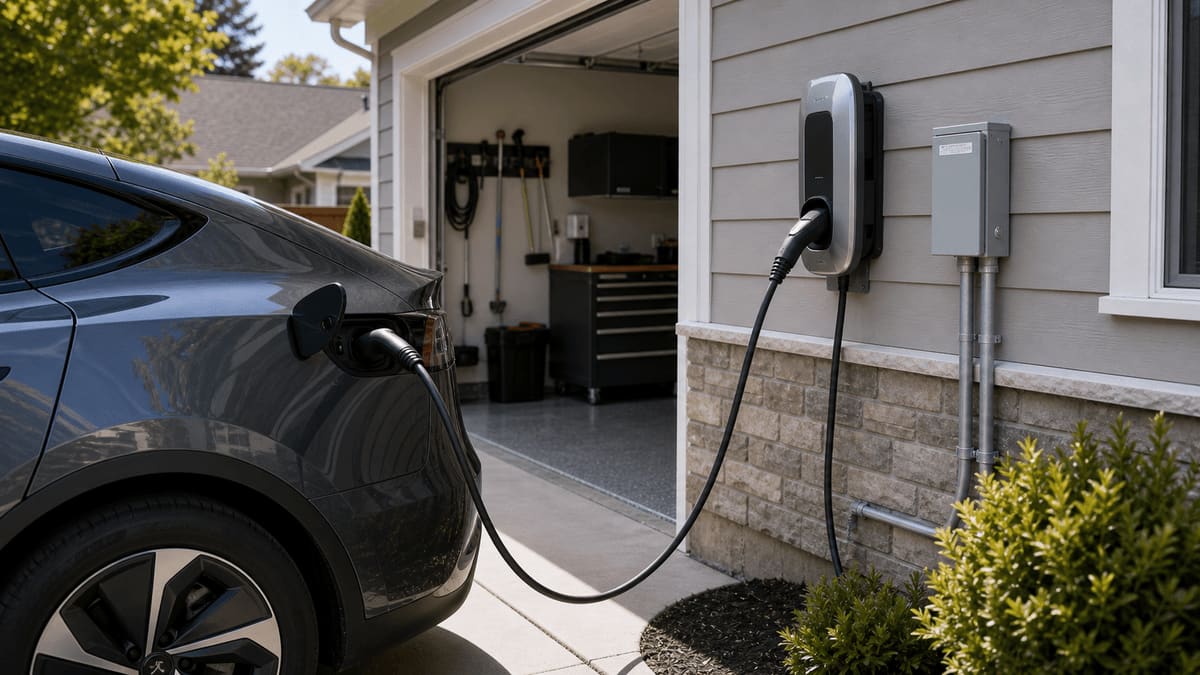
Level 1 vs Level 2
- Level 1 ($150–$500) — a 120-volt cord into a standard outlet, adding roughly 3–5 miles of range per hour. Fine for plug-in hybrids or low daily mileage, but slow for a full EV.
- Level 2 ($2,700–$4,700+) — a 240-volt circuit adding about 25–40 miles per hour, enough to fully recharge overnight. The practical choice for almost any battery EV.
Most homeowners installing for an EV want Level 2; the cost question is less about the charger and more about the wiring to reach it.
What drives the install cost
The charger itself is cheap; the install is where quotes diverge. Three factors set the price:
- Distance from the panel — a short run to a nearby panel ($2,700–$4,700) is far cheaper than a long conduit run ($4,200–$7,300) or a detached garage needing a trench ($11.76–$20/ft of trench).
- Panel capacity — the big variable. If your panel is full or undersized, you need a sub-panel ($882–$1,500) or a 200A main panel upgrade ($2,058–$3,500) before the charger.
- Outlet vs hardwired — a NEMA 14-50 outlet ($47–$80 plus install) suits a plug-in unit; hardwiring is required for high-amperage (80A) chargers and is the usual choice outdoors, though a listed outdoor-rated receptacle with an in-use cover and the required GFCI protection can be permitted — confirm with your electrician and local inspector.
Smart chargers and avoiding a panel upgrade
Chargers tier up from basic ($411–$700) to smart Wi-Fi units ($705–$1,200) that schedule charging to off-peak rates and track usage, to premium dual-port or 80-amp models ($1,176–$2,000). The smart features pay off most where your utility has time-of-use pricing. And if a panel upgrade is the only thing standing between you and a charger, ask about a load-management module ($470–$800): it lets a charger share existing capacity with other large loads, often avoiding a full ($2,058–$3,500) panel upgrade entirely. Check your local utility for EV-charging programs — many offer rebates or special charging rates.
Frequently asked questions
How much does it cost to install an EV charger in 2026?
Basic Level-2 install with existing 200A panel and a short run: $2,700-$4,700. Smart Level-2 with 50 ft run: $4,200-$7,300. Detached garage with trench: $6,000-$10,300. Charger + main panel upgrade: $6,300-$10,800. The federal Section 30C alternative-fuel-vehicle refueling property credit applied to property placed in service on or before June 30, 2026 in an eligible census tract; installs after that date generally do not qualify — verify with IRS Form 8911.
What amperage do I need?
The circuit is always larger than the charging current, because a charger is a continuous load and runs at no more than 80% of its breaker. Common pairings: a 40A circuit delivers 32A of charging (about 7.7 kW, roughly 200 miles overnight); a 50A circuit delivers 40A; a 60A circuit delivers 48A. 32A covers most overnight needs. A higher setting only helps if the car's onboard charger accepts it, so check the vehicle specification before paying for a bigger circuit, and follow the charger's listed installation table.
Plug-in vs hardwired?
Plug-in (NEMA 14-50 or 6-50) is portable and easy to swap chargers. Continuous current depends on the listed EVSE and the circuit it is on — commonly 32A on a 40A circuit, and up to 40A on a 50A circuit for units rated for it — so follow the manufacturer instructions and your locally adopted NEC (40A breaker × 80% derate). Hardwired allows 40-48A continuous and is safer for outdoor / damp locations. NEC 2023 actually requires GFCI on the breaker for plug-in installs.
Tax credits?
The federal Section 30C credit applied to eligible installs placed in service on or before June 30, 2026 (eligible census tracts, verify on IRS Form 8911); installs after that date generally do not qualify. State and utility incentives vary; many utilities offer $250-$500 rebates.
Can I DIY?
Strongly recommend pro. Permit + inspection required in nearly every jurisdiction; mistakes risk fire. NEC 2023 has specific GFCI / labeling requirements.
How much does it cost to install an EV charger at home?
A basic Level 2 on an existing panel with a short run is $2,700-$4,700; a smart charger on a 50 ft run $4,200-$7,300; a detached garage with trenching $6,000-$10,300; and a Level 2 that also needs a 200A panel upgrade $6,300-$10,800.
Level 1 or Level 2 EV charger?
Level 2 (240V, ~25-40 miles of range per hour) is the practical choice for a full EV and recharges overnight. Level 1 (120V cord, ~3-5 miles per hour) is fine for plug-in hybrids or low daily mileage.
Do I need a panel upgrade for an EV charger?
Only if your panel is full or undersized for the added load. A 200A upgrade runs $2,058-$3,500, but a load-management module ($470-$800) can let the charger share existing capacity and often avoids the upgrade. An electrician runs a load calc to confirm.