Gravel Cost Calculator (2026)

Planning estimate for tons, cubic yards, delivery, labor, and total cost on any gravel project — driveway, walkway, parking pad, shed pad, French drain, or decorative bed. Pick your material, depth, and site prep, and we'll compute a planning range.

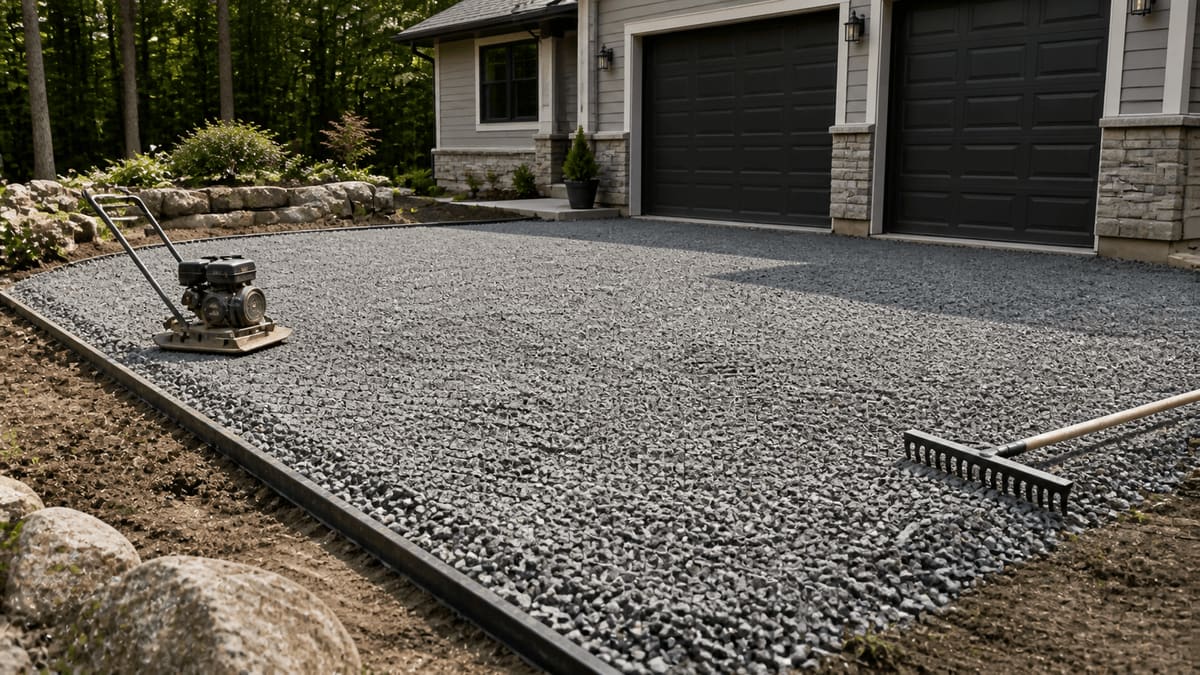
Freshly laid crushed-stone driveway with steel edging, a plate compactor, and a landscape rake in front of a two-car garage

Enter your gravel project

Includes labor, equipment, contractor markup, and permits.

Common projects

Project dimensions

Walkway 3-4 in · light driveway 4-6 in · medium 6-8 in · heavy 8-12 in. For French drains use full trench depth.

Material & site

Adjusts labor & material rates for your region.
Uses the first 3 digits as a planning zone (not exact local pricing). Overrides state average when matched.
Compacted layers need ~25% more material.

Your gravel estimate

Estimated installed range
Calculating…
Materials
$0
Labor
$0
Per sq ft
$0

Cost breakdown

ItemQuantityEstimated range
Planning estimate, not a bid. Numbers here are 2026 planning ranges informed by published cost guides and supplier benchmarks. Always get 2-3 local quotes for accurate pricing.
What's not included: hauling spoil dirt off-site, drainage piping or catch basins beyond the gravel itself, asphalt or concrete topcoat, snow plowing or seasonal regrading, and engineering or soil testing.

Bid check

Got a contractor quote? Compare it to the planning range. No contact details collected.

Quote per sq ft
$0
Range check
Scope risk
Add a quote amount to compare it against the current estimate.

Methodology & sources

What this is: a planning-range calculator informed by published 2026 cost guides (HomeGuide, Angi, LawnStarter, Hello Gravel), regional supplier price lists, and U.S. government data (BLS, USGS). It is not a contractor bid.

Material pricing is FOB-quarry / retail planning data from cost guides. Delivered prices add the truckload + short-load fees on top. Real supplier quotes vary 30-60% from these planning ranges.

Crew labor is presented as a loaded billing rate, not a raw wage. The range is informed by BLS OEWS occupation 47-2061 (Construction Laborers) wage data, then loaded with payroll burden, crew composition, equipment overhead, and contractor profit using industry-standard ratios. The OEWS wage on its own would understate billing rates.

Contractor markup is a planning band of 18-30% on installed projects, excluded for DIY-materials mode. Real markups vary by trade, region, and contractor.

Per-rate sources are stored in the underlying CSV with each row's source_url, source_date, region, and basis.

Last updated: May 2026. Full methodology →

How much does a gravel driveway cost in 2026?

A standard residential gravel driveway runs roughly $1 to $3 per square foot installed for a basic single-layer pour, or $4 to $10 per square foot for a properly built three-layer driveway with full prep, geotextile fabric, and edging. The average gravel driveway lands around $1,800 total; most projects fall between $500 and $3,500. These are planning ranges — your local quote may sit anywhere within or slightly outside this band depending on quarry distance, season, and labor market.

What drives gravel cost

  • Material type — crusher run is cheapest ($24-$34/ton); river rock can hit $150/ton in coastal markets.
  • Depth — doubling the depth roughly doubles the tons.
  • Compaction — compacted layers need ~25% more material.
  • Site prep — full excavation can add $4-$8/sq ft.
  • Delivery distance — over 20 mi from the quarry, deliveries add $50-$300 per load.
  • Edging & fabric — properly contained driveways with geotextile and steel edging cost more upfront but last 2-3x longer.
  • Region — California and New York labor run 30-35% above national average; areas near limestone or granite belts are cheaper.

Frequently asked questions

How many tons of gravel do I need?

For most crushed stone, 1 cubic yard weighs about 1.4 tons. To find tons: multiply length (ft) × width (ft) × depth (ft, divide inches by 12), divide by 27 to get cubic yards, then multiply by 1.4. Add 25% extra for compacted layers, 10% for loose fill.

What's the difference between #57 stone and crusher run?

Crusher run includes stone dust ("fines") that lock the stones together when compacted — structural, used as a base. #57 is washed 3/4 in stone with no fines — drains well but stays loose, used as a top course or in French drains. A good driveway uses both, in layers.

How thick should my gravel driveway be?

4-6 inches for occasional passenger cars, 6-8 inches for daily use, 8-12 inches for heavy use or commercial. Build it in three lifts (compacted base + middle + top) for anything thicker than 4 inches.

Do I need geotextile fabric under gravel?

Yes for any vehicle-bearing surface. Without it, gravel slowly sinks into the soil and pothole-prones the driveway, shortening the regrade cycle from every 5-10 years to every 1-2.

Common mistakes & questions

  • Skip 811 utility marking — call before digging, even for a shallow driveway.
  • Use the wrong size — pea gravel rolls underfoot; #57 packs hard for driveways.
  • Order by yards instead of tons — yards is volume, tons is weight; bulk yards include haul air space.
  • Forget compaction — uncompacted gravel settles 1-2 in within months.
  • Ask your contractor: stone size by layer, compaction method, edging plan, drainage slope.

When this estimate is wrong

  • Hard access (rural, second-floor, no parking nearby) adds 10-25%.
  • Trip charge minimums — most contractors have a $200-$500 minimum, even for small jobs.
  • Local code (energy, hurricane, seismic, historic) can require upgrades beyond IRC default.
  • Disposal fees — landfill costs vary by state; tear-off jobs hit hard in CA/NY.
  • Seasonality — winter/early spring quotes are 10-20% lower than peak summer.
  • Supplier minimums — small material orders often add 10-15% over bulk pricing.
  • Permit timeline — permits add days to weeks; failed inspections add cost.