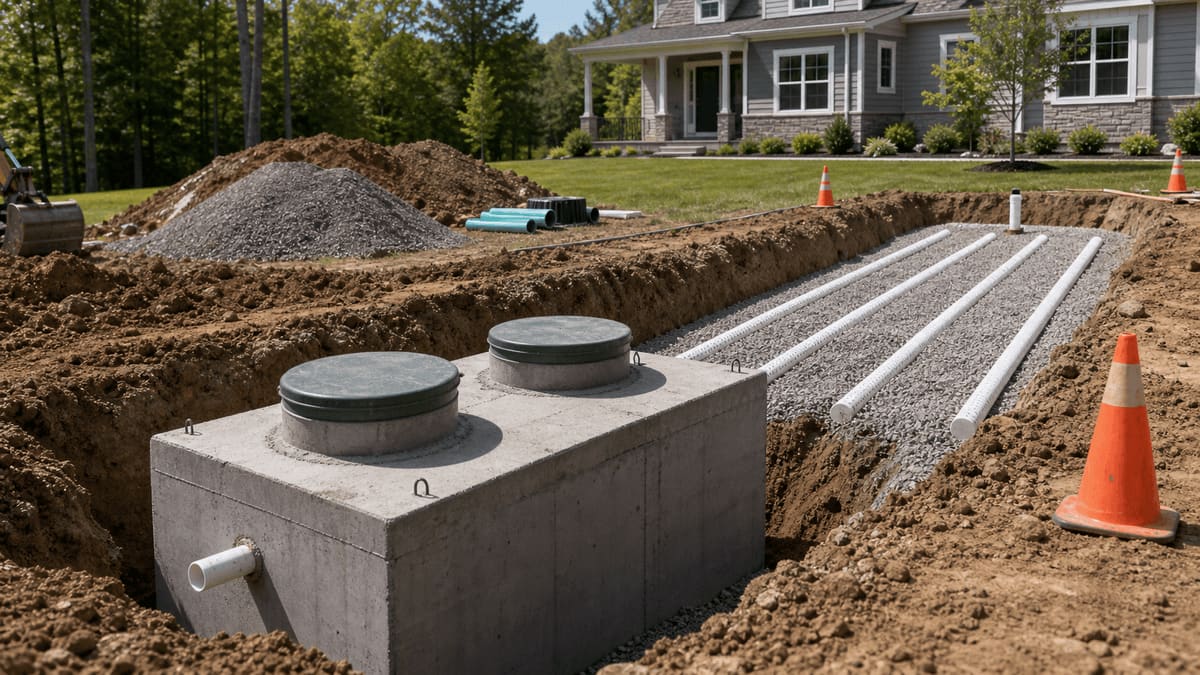
Tank material: concrete, plastic, or fiberglass
Tank size follows bedroom count (1,000 gallons is the standard for a 3-bedroom home), but the material is a real choice with cost and durability trade-offs:
| Material | Per gallon | 1,000-gal tank | Notes |
|---|
| Polyethylene (plastic) | $0.76 – $1.30 | $760 – $1,300 | Lightest and cheapest; can float in a high water table without proper anchoring |
| Concrete | $0.88 – $1.50 | $880 – $1,500 | The default — heavy, durable 30–50 years, won't float |
| Fiberglass | $1.18 – $2.00 | $1,180 – $2,000 | Corrosion-proof and premium; less common |
The tank is only part of the job — excavation, the drainfield, and design/permitting usually cost more than the tank itself.
When you can't use a conventional system
A perc test ($588–$1,000) measures how fast your soil absorbs water, and it decides everything downstream. Well-drained soil supports a conventional gravity drainfield — the cheapest option. Fail the perc and you move up a cost ladder:
- Chamber system — drainfield material $26–$45 per linear foot versus $18–$30 for conventional; a modest premium for tighter soils.
- Sand mound — $41–$70 per linear foot of material for high water tables or shallow bedrock; roughly doubles the drainfield cost.
- Aerobic treatment unit (ATU) — $7,059–$12,000 for the unit alone, plus ongoing electricity and service contracts, for the worst soils.
This is why the same 3-bedroom house can land at $13,200 or $31,000 — the difference is entirely what's under the yard, which is why the perc test comes before any design.
Septic maintenance and lifespan
A septic system fails fast if ignored and lasts decades if maintained — the upkeep is cheap relative to a failed drainfield:
- Pump the tank every 3–5 years ($300–$600). Sludge that overflows into the drainfield is the leading cause of premature field failure.
- Never drive or park on the drainfield — compaction crushes the pipes and ruins the soil's ability to absorb effluent.
- Keep roots away — trees within about 30 feet can invade and clog the field.
- Spread out water use — a field flooded by back-to-back laundry loads can't recover between them.
Tanks last 30–50 years and drainfields 20–30; an ATU's mechanical parts only 5–10. A pumped, protected system reaches the top of every range.
Frequently asked questions
How much does a septic system cost in 2026?
Conventional 3-bedroom system (1,000 gal tank, 100 LF drainfield, average soil): $13,200-$22,900. 4-bedroom chamber system: $16,300-$28,400. 3-bedroom sand mound on poor soil: $18,000-$31,000. Aerobic treatment unit (ATU) for very poor soil: $21,700-$38,300. Tank gallons follow bedroom count; drainfield LF scales with bedrooms and soil class.
What size tank do I need?
EPA / state code rule of thumb: 750 gal for 1-2 bedrooms, 1,000 gal for 3 BR, 1,250 gal for 4 BR, 1,500 gal for 5+ BR. Some states require larger. Concrete is the most common material; plastic is lighter and cheaper but less durable; fiberglass is premium and rare.
How does soil affect cost?
Well-drained sandy / loam soil is the cheapest baseline. Average mixed soil adds about 20% to excavation. Poor soil (heavy clay, shallow rock) adds 50%. Very poor soil that fails perc requires sand mound or aerobic treatment unit (ATU), which roughly doubles total system cost. A perc test ($300-$1,000) is required upfront to determine soil class.
How long do they last?
Tanks 30-50 yr. Drainfields 20-30 yr. ATU mechanical components 5-10 yr; biological media 1-2 yr.
DIY vs pro?
Septic is state-licensed designer + installer work. DIY essentially limited to opening manhole or replacing riser lid.
How often should you pump a septic tank?
Every 3-5 years for a typical household, or whenever sludge fills about a third of the tank. Pumping runs $300-$600. Skipping it is the leading cause of drainfield failure, which is a $5,000-$15,000+ repair.
How much does it cost to replace a septic tank?
A tank-only replacement that reuses the existing drainfield runs $4,000-$8,000. A full new system is $13,200-$22,900 for a conventional 3-bedroom setup and $21,700-$38,300 where poor soil forces a sand mound or aerobic treatment unit.
What happens if my soil fails the perc test?
You move to an alternative system. A sand mound (drainfield material $41-$70 per linear foot) or an aerobic treatment unit ($7,059-$12,000 for the unit alone) can treat soils a conventional gravity drainfield cannot - roughly doubling total system cost.