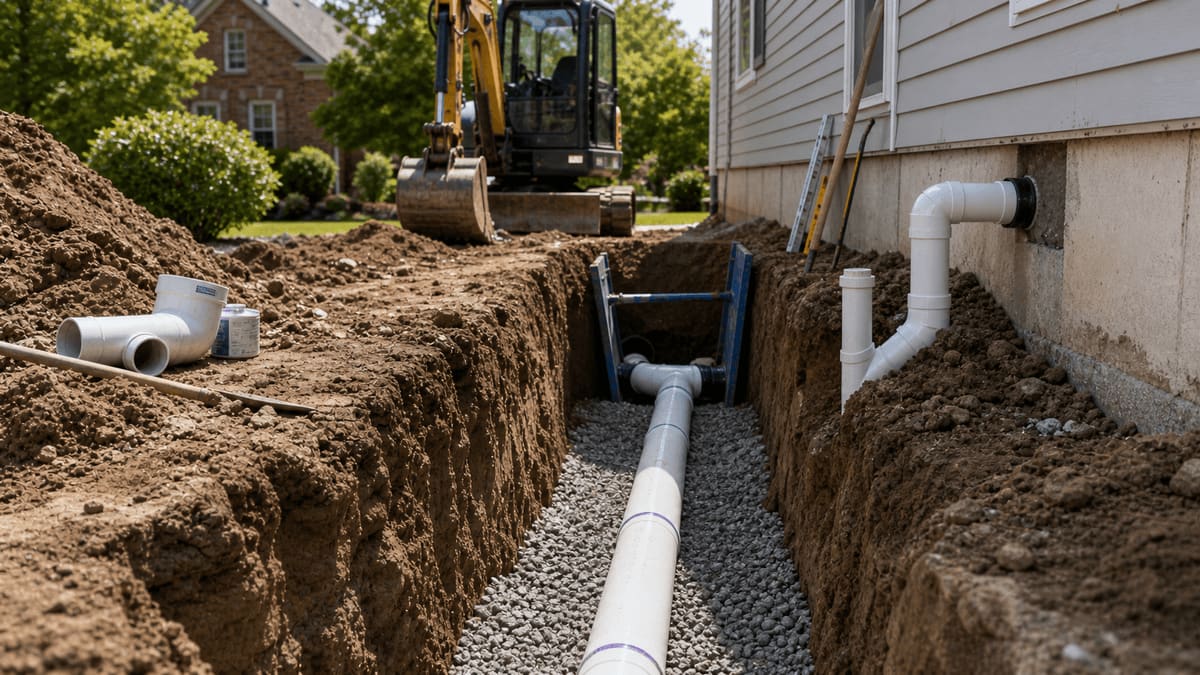
Sewer line cost by method
For a typical 50-foot residential lateral, the installation method sets the price:
| Method | How it works | 50-ft lateral |
|---|
| Open-trench | Dig the full run, lay new pipe | $8,900 – $16,300 |
| Pipe-burst (trenchless) | Pull new pipe through the old | $6,000 – $13,000 |
| Cured-in-place lining | Cure a liner inside the old pipe | $7,000 – $15,000 |
Work past the property line (the public right-of-way) adds permit and traffic-control cost.
Trenchless vs open-trench
The headline price isn't the whole story — restoration is:
- Open-trench — lowest per-foot cost, but it tears up everything above the line: lawn ($4–$7/sq ft to restore), driveway concrete ($11–$18), or asphalt ($8–$14). A "cheap" open dig under a driveway can end up the priciest option.
- Pipe-burst — two small access pits instead of a full trench; ideal when the old pipe is collapsed and you want to save the landscaping.
- Cured-in-place lining (CIPP) — the least digging, but it needs a structurally sound host pipe to line.
What drives the cost beyond method
Three factors swing a sewer bid: depth (each step deeper adds $12–$70 per foot as excavation gets harder), length of the run, and pipe material (PVC is cheapest at $4.50–$7.50/ft; HDPE and cast-iron cost more). Add cleanout installs ($350–$1,100) and surface restoration. The smartest first dollar is a camera inspection ($200–$400): it shows exactly where and why the line failed — roots, a belly, a collapse — so you fix the real problem, and a post-job camera run verifies the repair.
FAQ
How much does sewer-line replacement cost in 2026?
A 50-foot residential lateral runs roughly $8,900-$16,300 open-trench, $6,000-$13,000 trenchless pipe-burst, or $7,000-$15,000 cured-in-place lining. Right-of-way work past the property line adds permit and traffic-control cost.
Trenchless vs open-trench?
Trenchless saves landscape, hardscape, and tree roots, but needs intact endpoints and a host pipe in good enough shape (for lining) or pullable (for bursting). Open-trench is more disruptive but works on any soil/condition.
Do I need a permit to replace a sewer line?
Yes — every state requires a plumbing permit for sewer-line work, plus a separate right-of-way permit if any portion crosses the public side. Permits typically run $250-$600 residential and $500-$1,500 ROW.
How much does trenchless sewer line replacement cost?
For a 50-foot lateral, pipe-bursting runs $6,000-$13,000 and cured-in-place lining $7,000-$15,000. Both cost more per foot than open-trench ($8,900-$16,300) but avoid tearing up lawns and driveways, which often evens out the total.
Is trenchless sewer repair worth it?
Usually, when a dig would destroy a driveway, mature landscaping, or hardscape - the restoration savings offset the higher per-foot price. Pipe-bursting handles collapsed lines; lining needs a structurally sound host pipe to work.
How do I know if my sewer line needs replacing?
A camera inspection ($200-$400) is the definitive test. Recurring backups, multiple slow drains at once, sewage odors, or lush patches in the yard point to root intrusion, a belly, or a collapse in the lateral.
More questions
How do I know if my sewer line needs replacing?
Repeated backups, slow drains across all fixtures, sewage smell, mature trees over the line, soggy spots in the yard, or repeated camera-confirmed root intrusion. A camera inspection settles it.
Trenchless vs open-trench?
Trenchless saves landscape and hardscape but needs sound endpoints (lining) or a pullable alignment (bursting). Open-trench works on any soil/condition but tears up everything in its path.
Is sewer line replacement covered by insurance?
Most homeowner policies do NOT cover sewer-line replacement unless you carry a service-line endorsement. A few municipalities offer optional sewer-warranty programs.
What about tree roots?
Mechanical augering or hydro-jetting can clear roots short-term, but if the pipe is breached, replacement is the long-term fix. Trenchless lining encapsulates root entry points.
How long does the work take?
Open-trench residential lateral: 2-3 days. Pipe-burst: 1-2 days. CIPP lining: 1 day. Right-of-way work adds days for permitting.