Skylight Cost Calculator (2026)

Estimate skylight install or replacement — fixed, vented, solar, sun-tunnel. Pick model, light-shaft scope, and electrical. 2026 data; not a contractor bid.

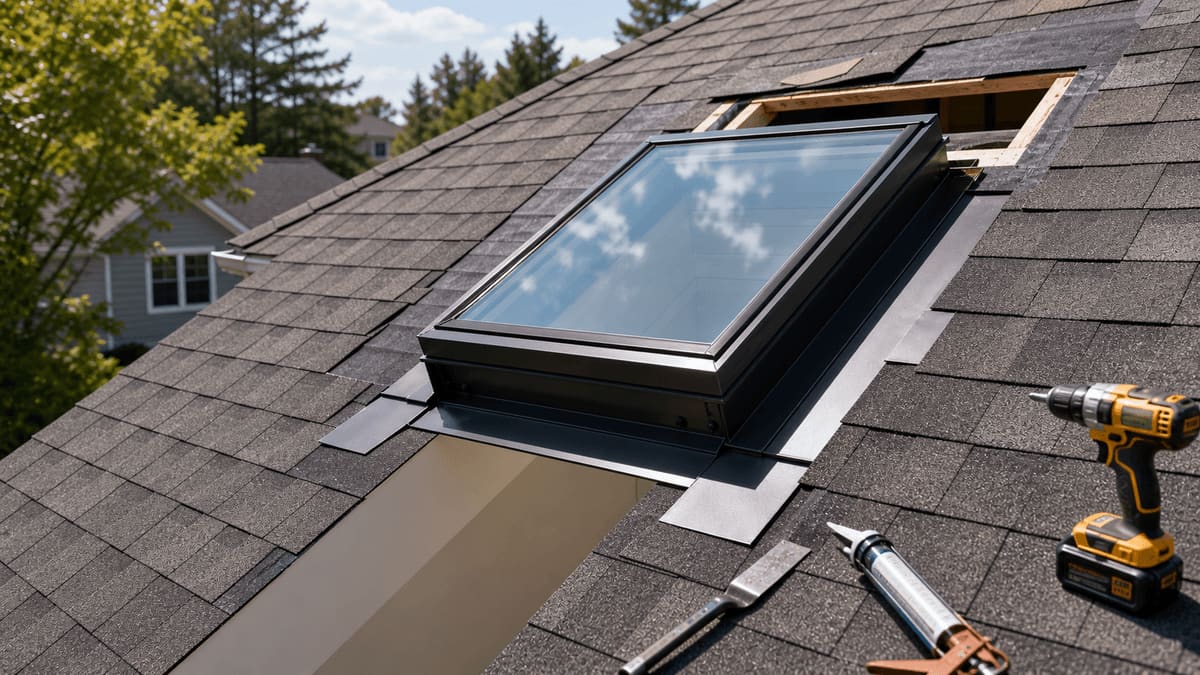
Newly installed deck-mounted fixed skylight in a residential gable roof with the flashing kit visible and a clean-cut opening from below in the attic

Enter your skylight project

Includes materials, labor, the permit and contractor markup; the breakdown below lists each line.

Common projects

Model & count

Uses the first 3 digits as a planning zone (not exact local pricing). Overrides state average when matched.

Scope & add-ons

Your skylight estimate

Estimated installed range
Calculating…
—
Materials
$0
Labor
$0
Per skylight
$0

Cost breakdown

Skylight cost breakdown: quantity and estimated range for each line item
ItemQuantityEstimated range
Planning estimate, not a bid. 2026 rates on this page cite HomeGuide (17 rows) and BLS wage data (2). Compare written bids on an identical scope for accurate local pricing.
What's not included: roof structural reinforcement (header replacement) for very large units, full roof replacement (separate calc), inside ceiling repaint outside the shaft area, or smart-home integration beyond the manufacturer remote.

Bid check

Got a contractor quote? Compare it to the planning range.

Not sure and Whole estimate compare with the whole estimate. Materials + equipment uses those lines alone, without labor lines or markup; items priced as installed work are left out and the result names them.
Quote
—
Range check
—
Scope risk
—
Add a quote amount to compare it against the current estimate.

Methodology & sources

What this is: a planning-range skylight calculator. Its rates cite HomeGuide and BLS wage data. The note under the estimate counts the rows from each source.

Labor is priced from per-unit installed rates, not by the hour. For reference, the rate file also lists a loaded crew rate ($82-$140 per crew-hour) built on BLS OEWS 47-2031 (Carpenters) and 47-2181 (Roofers).

Section 25D credit: some manufacturers marketed solar-powered venting skylights and motorized solar shades as eligible for the federal Section 25D residential clean-energy credit, which applied to property placed in service on or before December 31, 2025. No IRS guidance addresses skylights specifically, so that eligibility was never confirmed. Projects placed in service in 2026 do not qualify under current IRS guidance. For an amended 2025 return, ask a tax professional and see the IRS Residential Clean Energy Credit page before relying on it.

Last updated: November 2026. Full methodology →

Helpful materials & tools for this project

A skylight install is the unit plus the flashing that keeps it from leaking:

  • Skylight unit — Fixed, vented, or solar-powered.
  • Manufacturer flashing kit — Model-specific flashing — the leak-proofing.
  • Ice-and-water shield — Seals the curb and deck around the opening.

Suggested materials to help you plan — not an endorsement, and never a contractor referral.

Cost simulator

Monte Carlo simulation

See the full range of likely costs — with the odds

For a typical replace existing skylight, the installed planning band runs $2,749 to $5,320 nationally before regional adjustment.

What this project costs in different metros

Regional labor and material markets move the installed price. These bands come from the same engine as the calculator above, run at each metro's planning multipliers — enter your ZIP in the calculator for a figure tuned to your area. National reference: $2,750–$5,300.

Skylight typical installed cost by metro area, compared with the national reference
MetroTypical installed rangevs. national
San Francisco, CA$3,200–$6,350+19%
New York, NY$3,250–$6,450+20%
Boston, MA$3,000–$5,850+9%
Chicago, IL$3,050–$6,050+13%
Atlanta, GA$3,050–$6,000+12%
Houston, TX$2,900–$5,650+6%
Miami, FL$2,700–$5,250-1%
Phoenix, AZ$2,800–$5,500+3%

Planning ranges, not contractor quotes. Multipliers are rounded regional planning indices (see methodology), not a reproduction of any proprietary cost table.

What moves this price the most

Vary one input across its full range while holding everything else at the typical scenario, and this is how far each choice can move the installed estimate — measured by running the calculator's own engine. The widest bars are where your decisions matter most; the figures show the cheapest-to-priciest span each input creates on its own.

  • Number of skylights$4,050–$61,350
  • Model$1,950–$4,500
  • Inside shade / blind$4,050–$4,550
  • Add electrical (motorized)$4,050–$4,450
  • Replacing existing skylight$3,850–$4,050

A tornado view: each row varies a single input; a real project moves several at once, so totals aren't additive.

How much does a skylight cost in 2026?

ScopeRangeTimeline
Sun tunnel (10-14 in)$889-$1,7502-4 hours
Fixed skylight (small)$2,266-$4,0101 day
Fixed skylight (large)$2,785-$4,9201-2 days
Manual-venting skylight$2,404-$5,1301-2 days
Solar-powered venting skylight$3,412-$6,1701-2 days
Replace existing skylight (same opening)$2,749-$5,3201 day
Add a light shaft through an attic+$1,353-$2,300+1 day

One skylight, contractor installed at national average pricing, including the permit and trip charge; no light shaft unless noted. Sun tunnels never need one: the tube is the shaft. These rows come from the calculator above, so enter your ZIP there for local pricing.

Frequently asked questions

How much does skylight installation cost in 2026?

One skylight, contractor installed at national average pricing with the permit and trip charge and no light shaft: a small fixed skylight $2,266-$4,010, a large fixed one $2,785-$4,920, manual venting $2,404-$5,130, and solar-powered venting $3,412-$6,170 (2026 installs do not qualify for the expired federal Section 25D credit). Sun tunnels (tubular): $889-$1,750. Add $1,353-$2,300 for a light shaft if there's an attic above; sun tunnels and replacements in the same opening don't need one.

Are solar skylights eligible for the IRA tax credit?

Not for 2026 installs. Some manufacturers marketed solar-powered venting skylights and motorized solar shades as eligible for the federal Section 25D residential clean-energy credit, which applied to property placed in service on or before December 31, 2025, but no IRS guidance addresses skylights specifically, so that eligibility was never confirmed. For an amended 2025 return, ask a tax professional. Standard fixed and manual-vented skylights were never eligible.

Do skylights leak?

Properly flashed skylights from major manufacturers (Velux, Fakro, Sun-Tek) carry 10-yr no-leak warranties. Leaks come from improper flashing, especially around the curb and where the upper apron meets the roof. Use the manufacturer flashing kit, not generic step flashing.

Skylight vs sun tunnel?

Skylights ($2,266-$4,010 installed for a small fixed unit, up to $3,412-$6,170 for solar-powered venting, before any light shaft) need an opening cut, framed, and flashed in the roof; they daylight a room with a view. Sun tunnels ($889-$1,750) use a 10-14 in reflective tube to bring daylight to closets, hallways, or interior bathrooms with no real ceiling cut. Tunnels install in 2-3 hours; skylights take a day or two.

Can I DIY?

No, for the actual roof penetration. Manufacturer warranties typically void if not pro-installed, and a hidden leak can rot the roof deck and ceiling before it shows. Sun tunnel kits are pro-installed too.

Common mistakes & questions

  • Generic step flashing instead of the manufacturer kit — biggest leak source.
  • Skylight wider than the rafter spacing — the opening needs headers and extra framing, which this estimate does not price.
  • South-facing skylight without a shade — solar gain bakes the room in summer.
  • Skip the inside shaft drywall — exposed framing in attic looks unfinished.
  • Skip permit — many jurisdictions require it; insurance may deny leak claims if no permit.
  • DIY tubular sun tunnel install over an attic with insulation — needs an attic-side baffle.
  • Ask your contractor: manufacturer warranty, flashing kit (in-spec), shaft slope, glazing rating (Energy Star).

When this estimate is wrong

  • Steep roof (over 8/12 pitch) — labor +20-30%.
  • Tile / metal / slate roof — needs a flashing kit made for that roof and more labor; not priced here.
  • Engineered truss roof — an opening that cuts a truss needs an engineer’s design first.
  • Leak repair on an existing skylight — a separate scope this estimate does not price.
  • Hurricane-impact glass required (FL coastal) adds 30-60%.
  • HOA review of new openings.