How much does a water heater cost in 2026?
Water heater replacement runs $950 to $13,000 installed in 2026 depending on type. Tank-style is the budget option; heat-pump (HPWH) is the efficiency winner with strong rebates.
| System | Equipment | Installed | Lifespan |
|---|
| Electric tank (40 gal) | $350-$1,000 | $950-$2,200 | 10-15 yr |
| Gas tank (40 gal) | $400-$1,100 | $1,000-$2,500 | 10-15 yr |
| Electric tank (50 gal) | $400-$1,200 | $2,700-$4,600 | 10-15 yr |
| Gas tank (50 gal) | $500-$1,500 | $3,400-$5,900 | 10-15 yr |
| Electric tankless (whole-home) | $500-$1,500 | $3,900-$6,600 | 20+ yr |
| Gas tank (high-efficiency) | $800-$1,800 | $3,900-$6,700 | 12-18 yr |
| Heat-pump (50 gal) | $1,500-$3,000 | $4,800-$8,300 | 13-18 yr |
| Gas tankless | $1,000-$3,000 | $7,100-$12,400 | 20+ yr |
| Heat-pump (80 gal) | $2,000-$3,500 | $5,400-$9,100 | 13-18 yr |
| Gas condensing tankless | $1,800-$4,000 | $8,000-$13,700 | 20+ yr |
| Solar water heater | $3,000-$8,000 | $9,000-$18,000 | 20+ yr |
Not sure which type fits your home? Our tankless vs tank vs heat-pump cost comparison walks through install price, lifespan, and operating cost so you can see which is cheapest over 10 years.
Why installation costs more than the unit
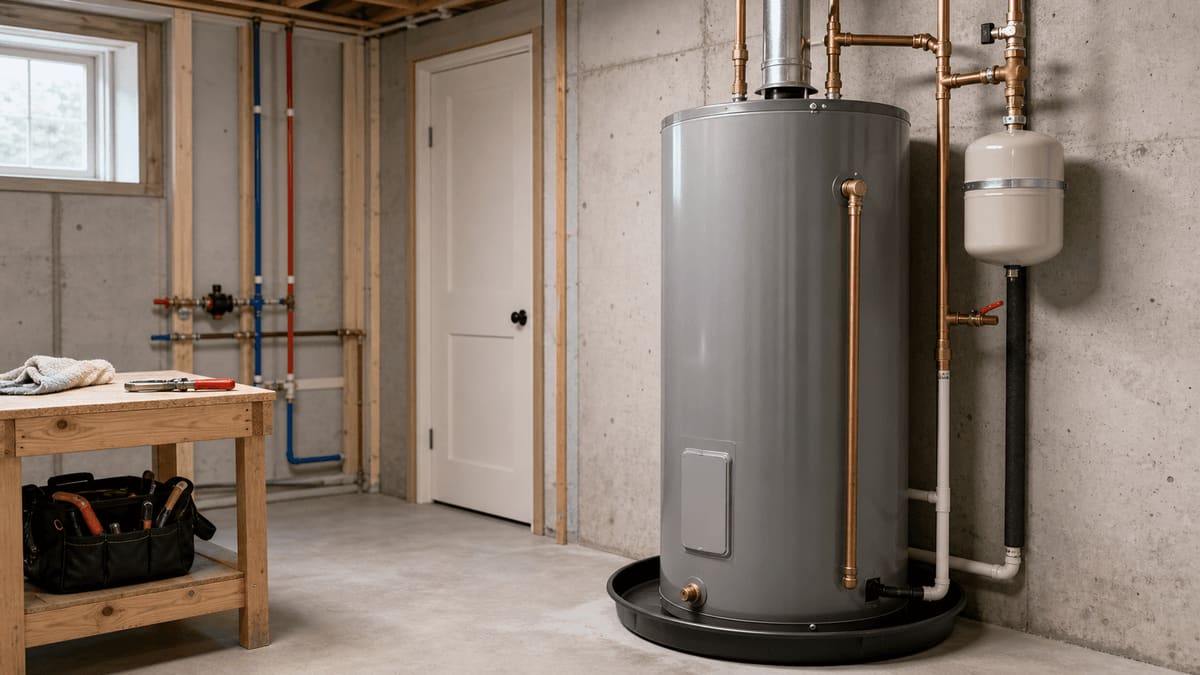
The gap between the equipment column and the installed column in the table above is not padding — it is the parts of the job that make the install safe and code-legal:
- Venting — gas units need correct flue or PVC power-vent runs; tankless conversions often re-vent entirely.
- Gas line — tankless burners draw far more gas than a tank; upsizing the line is a common adder.
- Expansion tank — required by code in most closed systems; cheap insurance against pressure damage.
- Drain pan and discharge piping — required above finished space; the T&P relief valve must terminate legally.
- Electrical — heat-pump and electric tankless units may need new circuits at panel capacity you may not have.
- Permit and inspection — most jurisdictions require one for water heater replacement; unpermitted swaps surface during home sales.
- Old-unit disposal and code catch-up — older homes often owe seismic strapping, bonding, or flue corrections the new permit forces.
This is why a "$450 water heater" becomes a $1,400 invoice — and why quotes that look suspiciously cheap usually exclude the code items the inspector will flag.
Repair or replace?
Repairable: heating elements and thermostats on electric tanks, thermocouples and gas valves on gas tanks, anode rods (the single best longevity maintenance item), and relief valves. These are modest fixes that make sense on a unit under about 8 years old.
Not repairable: a leaking tank. Once the inner tank corrodes through, replacement is the only fix — no sealant or weld survives the pressure and heat cycling. Water pooling under the unit, rusty hot water, or rumbling sediment noise on a 10–15-year-old tank are end-of-life signals; replacing on your schedule beats replacing during a flooded-floor emergency.
Age rule of thumb from the lifespan column above: under 8 years, lean repair; over 10, lean replace; in between, decide by the cost of the fix versus the remaining life you are buying.
75 and 80-gallon water heaters for large households
Standard 40–50 gallon tanks cover most homes, but households of five or more — or homes with a soaking tub, multiple simultaneous showers, or a high-flow fixture — step up to 75 or 80 gallons. Sizing by fuel:
- 75-gallon gas tank — roughly $1,800–$4,000 installed; the high recovery rate of gas means a 75-gal gas tank often serves a big household as well as an even larger electric one.
- 80-gallon electric tank — about $1,500–$3,000 installed; simpler install but slower to reheat than gas.
- 80-gallon heat-pump (HPWH) — $3,500–$6,000 installed; the efficiency choice for large all-electric homes, needs ~1,000 cu ft of space.
Bigger isn't automatically better: an oversized tank wastes standby energy keeping water hot you don't use. Match the tank to your peak simultaneous demand, or consider a high-capacity tankless if space is tight.
Frequently asked questions
How much does water heater replacement cost in 2026?
Gas or electric tank water heater swap runs $3,400-$5,900 installed in 2026. Switching to gas tankless (new venting + gas line) $7,100-$12,400. Heat-pump (HPWH) $4,800-$8,300. Solar systems typically run well above tank swaps once collectors and storage are installed - model it in the calculator. The federal Section 25C energy-efficient home improvement credit applied for property placed in service on or before December 31, 2025. Projects placed in service in 2026 generally do not qualify under current IRS guidance — verify on IRS Form 5695 and the IRS Residential Clean Energy Credit page before relying on it.
Tank vs tankless?
Tank water heaters are 50-70% cheaper installed but use more energy and last 10-15 years. Tankless heaters cost 2-3x more upfront but last 20+ years and only heat water on-demand. Tankless usually requires gas line resizing and PVC venting.
Should I get a heat-pump water heater?
HPWHs are the most efficient electric option (UEF 3.0+ vs 0.95 for resistance); utility rebates — and, for units placed in service on or before December 31, 2025, the federal Section 25C credit — can bring net cost close to a basic electric tank. They need 1,000+ cu ft of space and produce cool air, so unconditioned garages or basements work best.
What size do I need?
1-2 people: 30-40 gal. 2-3 people: 40 gal. 3-4 people: 50 gal. 5+ people: 75-80 gal. Tankless sized by GPM flow rate (3-7 GPM typical for whole-home).
Do I need a permit?
Most jurisdictions: yes ($50-$200). Fuel-switching (gas to HPWH) usually requires combined plumb + gas + electrical permits ($200-$500). Permits trigger inspections that catch venting and gas-pressure issues.
Why does the calculator show a price range?
Brand, capacity, venting condition, gas-line size, electrical, and permit fees all swing the total 30-60%. A range gives an honest planning estimate.
How much does it cost to replace a 50-gallon gas water heater?
A like-for-like 50-gallon gas tank swap runs $3,400-$5,900 installed in 2026. The spread is mostly venting condition, expansion tank and pan requirements, and local permit cost - not the unit itself. High-efficiency gas tanks run $1,500-$3,500.
How long does a water heater last?
Standard gas and electric tanks: 10-15 years. Heat-pump units: 13-18. Tankless: 20+. Hard water shortens tank life through sediment and anode consumption; flushing the tank yearly and replacing the anode rod around year 5 are the two maintenance items that actually move the number.
Can I replace a water heater myself?
Many jurisdictions require a permit and some require a licensed plumber, especially for gas. The risks are real: gas leaks, flue backdrafting carbon monoxide, scald-temperature misadjustment, and relief-valve piping mistakes. An electric like-for-like swap is the most DIY-realistic case; gas and any fuel-type conversion belong with a pro.
How much does a 75-gallon water heater cost?
A 75-gallon gas tank runs about $1,800-$4,000 installed, an 80-gallon electric tank $1,500-$3,000, and an 80-gallon heat-pump unit $3,500-$6,000. These large sizes suit households of five or more or homes with high simultaneous hot-water demand.