How much does it cost to build a porch in 2026?
Porch cost is driven first by type — whether it has a roof, screens, or glass walls — and then by size and finish. Open porches are essentially decks; covered, screened, and 3-season porches add structure, so the per-square-foot cost rises as you add roof, screens, and glass walls.
| Porch type | Installed / sq ft | 16x12 (192 sf) | Best for |
|---|
| Open (roofless) | $30 – $60 | $5,800 – $11,500 | Front stoop, entry landing |
| Covered (roof) | $70 – $135 | $13,500 – $26,400 | Shaded sitting porch |
| Screened | $70 – $130 | $13,500 – $25,000 | Bug-free 3-season use |
| 3-season (glass / vinyl walls) | $120 – $220 | $23,000 – $42,000 | Spring-through-fall room |
What drives porch cost
- Type — each step from open → covered → screened → 3-season adds roof, ceiling, walls, and glazing.
- Floor — a concrete slab ($6-$12/sf installed) is far cheaper than a raised composite deck floor ($32-$60/sf with substructure).
- Roof — a gable roof costs more than a shed roof but sheds snow and water better and looks more finished.
- Foundation — a covered porch needs footings sized for roof load; sloped or rocky sites add cost.
- Electrical — a ceiling fan, lights, and code outlets add roughly $400-$2,500.
- Region — California and New York labor run 30-35% above the national average.
Porch type, explained
Open porch
A roofless raised floor at the entry — effectively a deck used as a front porch. Cheapest option ($30-$60/sf). A guardrail is required once the floor sits 30 inches or more above grade.
Covered porch
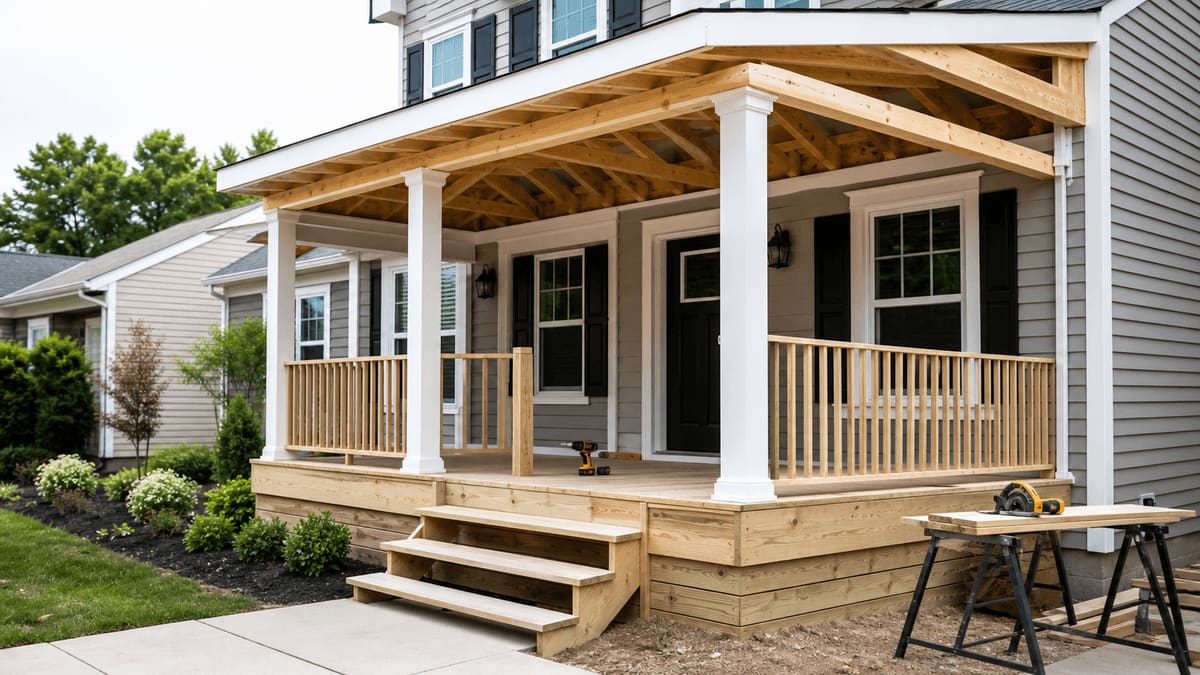
Adds a roof and finished ceiling over the floor ($70-$135/sf). The roof must be framed for local snow and wind load and tied into the house wall with proper flashing. This is the classic shaded sitting porch.
Screened porch
A covered porch with insect-screen walls and a screen door ($70-$130/sf). It delivers most of the comfort of an enclosed room at a fraction of a sunroom's cost, and is the most popular upgrade in the Southeast.
3-season room
Encloses the porch with vinyl or single-pane glass window walls ($120-$220/sf) for spring-through-fall use. It is not insulated or conditioned for winter like a full four-season sunroom, which is why it costs less.
Frequently asked questions
How much does it cost to build a porch in 2026?
An open porch runs about $30-$60 per square foot installed in 2026. A covered porch runs $70-$135 per square foot. A screened porch runs $70-$130 per square foot. A 3-season room (glass or vinyl walls) runs $120-$220 per square foot. A 16x12 (192 sq ft) covered porch typically costs $13,500-$26,400.
How much does a screened-in porch cost?
A screened porch costs roughly $70-$130 per square foot installed, including the floor, roof, ceiling, and screen system. A 16x14 (224 sq ft) screened porch typically costs $16,000-$30,000. Adding screening to an existing covered porch is far cheaper at $5-$15 per square foot of wall.
Do I need a permit to build a porch?
Almost always for a covered, screened, or enclosed porch, because it adds roof structure and often a foundation. Permit fees range from $75 to $500+ by jurisdiction. Open, ground-level porches are sometimes exempt below a local size threshold. Confirm with your local building department.
What is the difference between a porch, a deck, and a 3-season room?
A deck is an open raised floor with no roof. A porch is typically attached to the house and usually covered by a roof. A screened porch adds insect screen walls. A 3-season room encloses the space with glass or vinyl window walls for spring-through-fall use, but is not insulated for winter like a full sunroom.