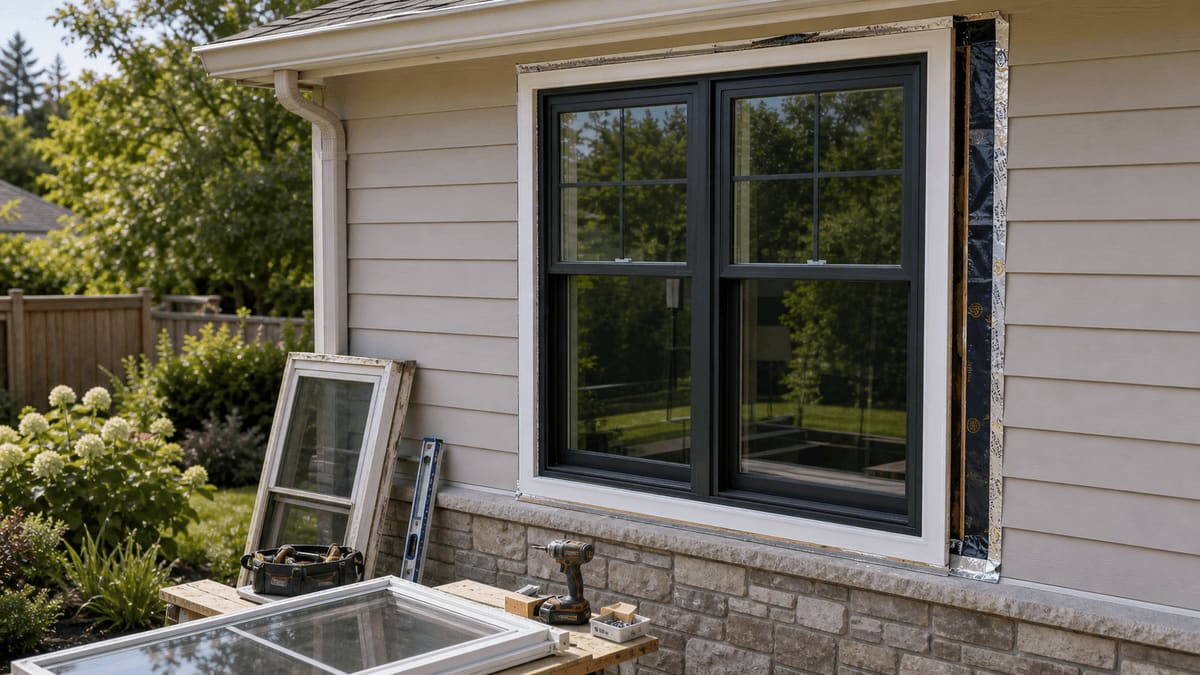
How much does window replacement cost in 2026?
Window replacement runs $400 to $1,800 per window installed in 2026 depending on material and install method. Vinyl is the value choice; fiberglass and wood are the long-life premium options.
| Material | Window only | Installed (insert) | Installed (full-frame) |
|---|
| Vinyl - double-hung | $300-$650 | $450-$1,000 | $600-$1,300 |
| Vinyl - casement | $400-$800 | $550-$1,150 | $700-$1,450 |
| Aluminum-clad wood | $550-$1,000 | $700-$1,350 | $850-$1,650 |
| Wood - double-hung | $600-$1,200 | $750-$1,550 | $900-$1,850 |
| Fiberglass - double-hung | $700-$1,100 | $850-$1,450 | $1,000-$1,750 |
| Wood - casement | $750-$1,500 | $900-$1,850 | $1,050-$2,150 |
| Bay / bow window | $2,000-$4,000 | $2,650-$5,850 | $2,800-$6,150 |
Whole-house window replacement cost
Per-window pricing from the table above scales almost linearly, with one helpful exception: contractors price multi-window jobs more efficiently than the single-window math suggests, because mobilization, setup, and disposal are shared. Whole-house bids commonly land 10–20% under the per-window total.
| Windows | Vinyl (insert) | Vinyl (full-frame) | Fiberglass (insert) |
|---|
| 5 | $5,400 – $9,300 | $6,700 – $11,600 | $8,000 – $13,900 |
| 10 | $9,700 – $16,700 | $12,100 – $20,900 | $14,200 – $24,100 |
| 15 | $14,100 – $24,200 | $17,500 – $30,300 | $20,600 – $34,900 |
| 20 | $18,000 – $30,900 | $22,400 – $38,700 | $26,300 – $44,600 |
Ranges multiply the installed per-window costs in the material table ($450–$1,000 vinyl insert, $600–$1,300 vinyl full-frame, $850–$1,450 fiberglass insert). Mixing sizes — a couple of large openings, a bay window, basement egress — moves a real bid around inside these bands, which is what the calculator above is for.
Insert or full-frame?
Insert (pocket) replacement sets the new window inside the existing frame. It is faster, cheaper, and doesn't disturb interior trim or exterior cladding — the right call when frames are square, dry, and sound. The trade-off is slightly less glass area, since the new unit nests inside the old frame.
Full-frame replacement strips the opening to the rough framing and rebuilds with new flashing, insulation, and trim. It costs $150–$300 more per window but is the only correct fix for rotted frames, chronic leaks, out-of-square openings, or when you're changing window size or style. It is also the standard for egress upgrades, where bedroom code requires a minimum clear opening.
A practical rule: probe the sill and lower frame corners with a screwdriver. Soft wood anywhere means full-frame — an insert over rot just hides a problem that keeps growing.
Glass packages: where the quote quietly grows
The frame material gets the attention, but the glass package moves the price just as much. Double-pane with Low-E coating and argon fill is the 2026 default and what the table ranges assume. Upgrades stack from there: triple-pane for cold climates and street noise, laminated glass for security and sound, tempered glass where code requires it (near doors, floors, tubs), and obscure glass for baths.
When comparing bids, line the glass specs up side by side — U-factor (insulation, lower is better) and SHGC (solar gain, climate-dependent) — rather than brand names. Two "vinyl double-hung" quotes $200 apart per window are often quoting different glass, not different quality.
Frequently asked questions
How much does window replacement cost in 2026?
Vinyl $400-$1,000/window installed, fiberglass $900-$1,700, wood $800-$1,800. Whole-house 10-window vinyl: $5,000-$10,000. Whole-house fiberglass full-frame: $17,800-$30,100.
Insert vs full-frame replacement?
Insert (pocket) replacement keeps the existing frame and adds $150-$350/window labor. Full-frame removes the frame down to the rough opening — costs $150-$300/window more, but the right call if frames are rotted or sized changing.
Do I need a permit to replace windows?
Like-for-like inserts are permit-exempt in many jurisdictions. Full-frame replacement, opening-size changes, and new egress windows usually require a permit ($50-$500).
Are vinyl windows cheaper than wood?
Vinyl is roughly 40-60% cheaper supply-side, but the gap closes installed because labor is similar. Vinyl typically lasts 20-30 years; clad-wood and fiberglass 30-50+.
What's the cheapest way to replace windows?
Insert vinyl in a like-for-like opening with no trim work and no permit. Buying in bulk through a distributor or warehouse store helps too — manufacturer offers can shave 10-20%.
Why does the calculator show a price range?
Brand, glass package (Low-E, argon, triple-pane), opening condition, and installer skill all swing the total 30-60%. A range gives an honest planning estimate.
How much does it cost to replace all windows in a house?
A 10-window house runs $4,500-$10,000 with vinyl inserts, $6,000-$13,000 vinyl full-frame, and $8,500-$14,500 with fiberglass inserts. A 20-window house roughly doubles that. Whole-house bids often come in 10-20% under per-window math because setup and disposal are shared.
When should windows be replaced?
Clear signals: fog or condensation between panes (failed seal), soft or rotted frame wood, sashes that will not stay open, persistent drafts, and single-pane glass in a cold climate. Most vinyl windows are due around 20-30 years; failed seals can be a one-window fix if frames are sound.
Is it cheaper to replace all windows at once?
Per window, yes - contractors share mobilization, scaffolding, and disposal across the job, and manufacturers discount volume orders, typically saving 10-20% versus replacing a few at a time. Phasing by elevation (worst side first) is the usual compromise when the whole house is not in the budget.