Tile Cost Calculator (2026)

Estimate the cost to install tile for backsplashes, bath floors, and shower walls. Pick area, material, layout, substrate, and waterproofing. 2026 data; not a contractor bid.

By Martin Lashgari, Ph.D., P.E., PMP · Last reviewed July 2026

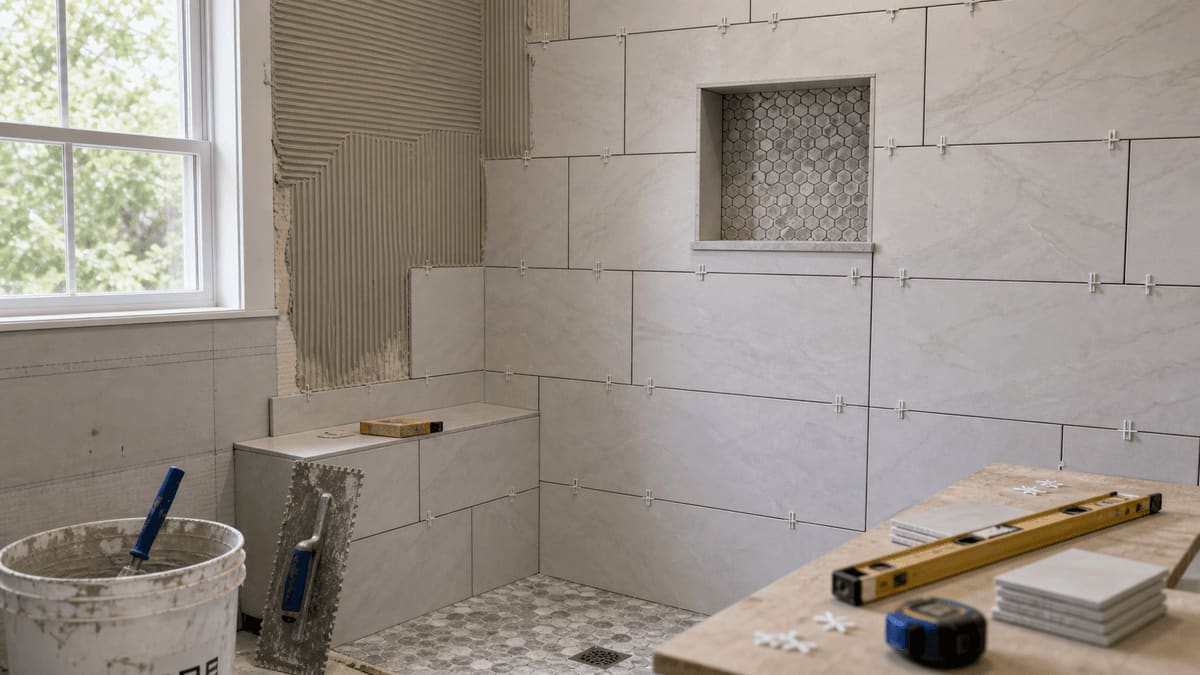
Bathroom shower mid-tile-install with white subway tile on the walls, hex-mosaic tile on the floor, Schluter edge trim, and tile spacers visible

Enter your tile project

Includes labor, equipment, and contractor markup.

Common projects

Area & material

Uses the first 3 digits as a planning zone (not exact local pricing). Overrides state average when matched.

Substrate & trim

Shower add-ons (optional)

Demo, sealer & permit

Your tile estimate

Estimated installed range
Calculating…
Materials
$0
Labor
$0
Per sq ft
$0

Cost breakdown

Tile (Bath / Backsplash / Shower) cost breakdown: quantity and estimated range for each line item
ItemQuantityEstimated range
Planning estimate, not a bid. 2026 ranges informed by Schluter, Custom Building Products (Redgard), HomeGuide, HomeAdvisor, Homewyse, and NTCA installer data.
What's not included: wall demo and replacement, plumbing valve relocation, glass shower-door enclosure, drain rough-in plumbing, lead-paint or asbestos abatement on pre-1978 substrates, and floor leveling / self-leveler beyond cement board.

Bid check

Got a tile-setter quote? Compare it to the planning range.

Quote per sq ft
$0
Range check
Scope risk
Add a quote amount to compare it against the current estimate.

Methodology & sources

What this is: a planning-range tile calculator informed by 2026 cost guides (HomeGuide, HomeAdvisor, Homewyse), TCNA Handbook installation methods, and manufacturer pricing (Schluter, Custom Building Products, Mapei, Daltile).

Material pricing is per-sf retail. 10% waste added (15% for diagonal/herringbone). Mosaic priced per sheet-equivalent.

Labor is modeled from per-unit installed rates with a crew-rate sanity check ($55-$95/crew-hr loaded billing rate), informed by BLS OEWS 47-2044 (Tile and Stone Setters).

Last updated: July 2026. Full methodology →

Helpful materials & tools for this project

A tile job is the tile plus the setting materials that make it last:

  • Wall or floor tile — Ceramic, porcelain, or stone, with waste factored in.
  • Thinset & grout — The mortar bed and joint filler.
  • Backer board & waterproofing — The substrate for wet areas like showers.
  • Tile spacers & a wet saw — For even joints and clean cuts.

Suggested materials to help you plan — not an endorsement, and never a contractor referral.

Cost simulator Monte Carlo simulation See the full range of likely costs — with the odds

For a typical kitchen floor, the installed planning band runs $2,929 to $5,202 nationally before regional adjustment.

What this project costs in different metros

Regional labor and material markets move the installed price. These bands come from the same engine as the calculator above, run at each metro's real cost multipliers — enter your ZIP in the calculator for a figure tuned to your exact area. National reference: $2,950–$5,200.

Tile (Bath / Backsplash / Shower) typical installed cost by metro area, compared with the national reference
MetroTypical installed rangevs. national
San Francisco, CA$3,650–$6,500+24%
New York, NY$3,700–$6,600+26%
Boston, MA$3,300–$5,850+12%
Chicago, IL$3,450–$6,150+18%
Atlanta, GA$3,400–$6,050+16%
Houston, TX$3,150–$5,600+8%
Miami, FL$2,950–$5,2000%
Phoenix, AZ$3,050–$5,400+4%

Planning ranges, not contractor quotes. Multipliers are rounded regional planning indices (see methodology), not a reproduction of any proprietary cost table.

What moves this price the most

Vary one input across its full range while holding everything else at the typical scenario, and this is how far each choice can move the installed estimate — measured by running the calculator's own engine. The widest bars are where your decisions matter most; the figures show the cheapest-to-priciest span each input creates on its own.

  • Tile area (sq ft)$2,050–$16,450
  • Electric heated floor (sf)$4,050–$7,150
  • Tile material$3,750–$6,650
  • Niches$3,600–$5,950
  • Edge trim (lf)$3,750–$5,900
  • Substrate / waterproofing$4,000–$4,900

A tornado view: each row varies a single input; a real project moves several at once, so totals aren't additive.

How much does tile cost in 2026?

Tile installation runs $7 to $50+ per square foot installed in 2026 depending on material, layout, and substrate. Ceramic and subway are budget; mosaic and natural-stone are premium.

MaterialMaterial/sfInstalled/sfUse case
Ceramic field tile$1-$10$7-$25Walls, dry floors
Subway$2-$15$8-$30Backsplash, walls
Porcelain field tile$3-$15$10-$30Wet floors, exterior
Large-format$5-$25$13-$45Modern floors, walls
Natural stone$7-$30$15-$50Premium floors, accent
Mosaic (glass/stone)$10-$50$20-$75Accent, niches, shower floor
Designer / handmade$15-$50$25-$70Statement walls

Frequently asked questions

How much does tile cost in 2026?

Ceramic tile runs $7-$25/sf installed in 2026. Porcelain $10-$30/sf. Mosaic $20-$75/sf. Natural stone (marble, travertine) $15-$50/sf. A 35 sf kitchen backsplash runs $250-$900 in subway; a 75 sf shower with Kerdi waterproofing $1,500-$4,000.

Ceramic vs porcelain tile?

Porcelain is denser, harder, less porous, and rated for wet/exterior use — but costs 30-50% more than ceramic. Ceramic is fine for wall and dry-floor applications. For shower floors and outdoor use, porcelain is the safer bet.

Do I need waterproofing in a shower?

Yes — modern code requires a waterproof barrier behind tile in showers. Schluter Kerdi (sheet membrane, $1.50-$4/sf) is the gold standard; Redgard or Aquadefense (liquid, $0.50-$1/sf) is the budget alternative. Mortar-bed shower pans ($5-$15/sf) are traditional.

Subway tile vs penny round vs hex?

Subway is timeless and cheap ($2-$15/sf). Penny round and hex are mosaic ($10-$50/sf), best for accents or shower floors. Larger format reduces grout joints and labor.

Can I install tile myself?

Standard floor and wall tile is moderate-difficulty DIY. Mosaic, herringbone, and large-format require more skill. Shower tiling is high-stakes — waterproofing failures cause expensive water damage. Many DIYers do floors but hire pro for showers.

Why does the calculator show a price range?

Tile brand, layout pattern, substrate condition, waterproofing system, and shower add-ons swing the total 30-60%. A range gives an honest planning estimate.

Common mistakes & questions

  • Waterproofing is non-negotiable in showers — Schluter Kerdi or equivalent membrane required by code.
  • Backsplashes don't need waterproofing, only thinset over drywall — different prep, different cost.
  • Wrong substrate — tile over green-board flexes and cracks; always use cement board or membrane behind wet-area tile.
  • Slope-to-drain — shower floors need 1/4 in per foot slope; flat floors pool.
  • Mosaic install is slower — figure 1.5-2x labor vs standard tile.
  • Ask your tile setter: waterproofing system, substrate, slope plan, niche/curb/bench detail, grout type (epoxy for showers).

When this estimate is wrong

  • Substrate prep decides the price — cement backer board or an uncoupling membrane over a sound, flat subfloor is required for a lasting job, and leveling a wavy floor first adds labor before a single tile is set.
  • Wet areas need real waterproofing — showers and tub surrounds require a proper membrane system and a sloped pan; this is code-driven work, not an upgrade, and it separates a shower price from a plain floor.
  • Layout, size, and waste move the labor — diagonal patterns, large-format tile, and busy rooms with many cuts mean more time and more tile waste than a straight, small-format floor.
  • Niches, curbs, benches, and edge trim add up — each built-in and every run of Schluter or bullnose edge is detail work priced beyond the field tile.
  • Demo of old tile is its own line — chipping out old tile and thinset, and sometimes the substrate under it, is dusty, slow work that a fresh-install figure omits.
  • Floor, wall, and shower-pan complexity differ — the same square footage costs very differently on a flat floor versus a wall versus a custom shower.
  • Small jobs carry a minimum — a single backsplash or a small floor rarely scales down to the per-square-foot rate a large job earns.