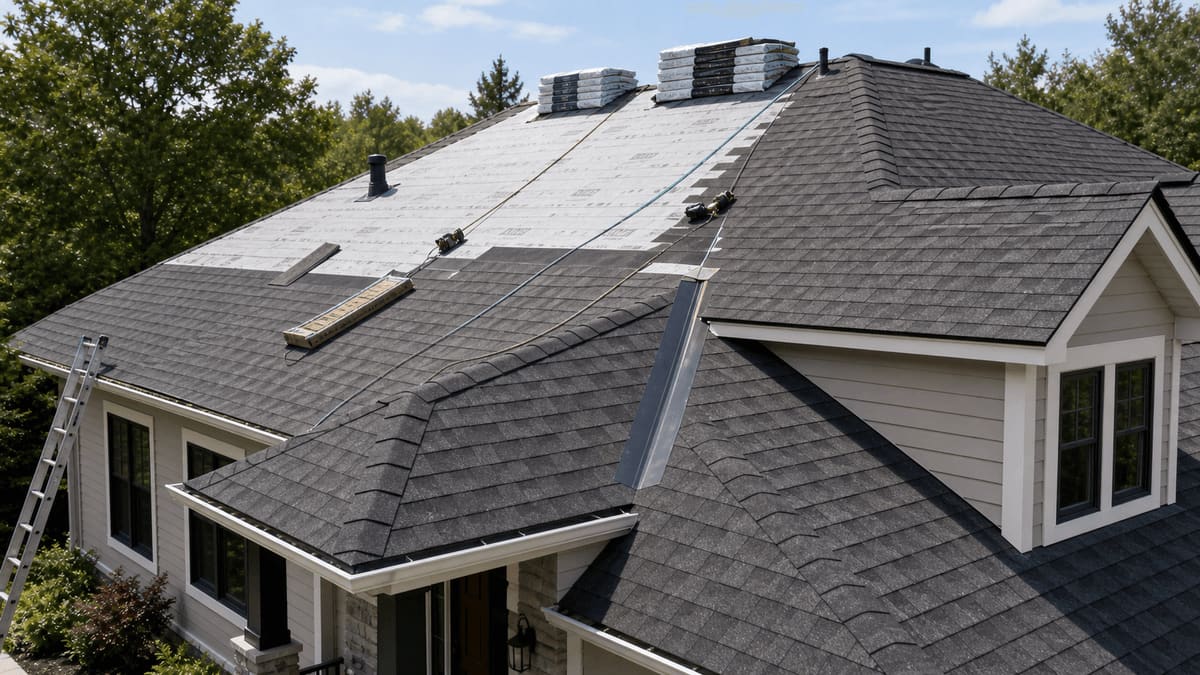
How much does a roof replacement cost in 2026?
Most full residential roof replacements run $10,900 to $20,000 in 2026 for a typical 1,500-2,000 sq ft footprint. Material is the biggest swing — asphalt 3-tab at $4.50-$7.50/sq ft is the cheap end, slate at $25-$30/sq ft is the high end.
| Material | Per square (mat. only) | Per sq ft installed | Lifespan |
|---|
| Asphalt 3-tab | $90-$120 | $4.50-$7.50 | 20-25 yr |
| Architectural asphalt | $120-$180 | $6.00-$9.00 | 30 yr |
| Metal (exposed fastener) | $250-$500 | $6-$10 | 40-50 yr |
| Metal (standing seam) | $350-$700 | $10-$16 | 50+ yr |
| Concrete tile | $400-$700 | $11-$17 | 50+ yr |
| Clay tile | $600-$1,200 | $15-$25 | 75+ yr |
| Slate | $1,500-$3,000 | $25-$30 | 100+ yr |
| Cedar shake | $400-$700 | $8-$15 | 30+ yr |
What drives roofing cost
- Material — asphalt to slate is a 6-7x range.
- Pitch — a 6/12 roof has 12% more surface area than a flat one; 12/12 has 41% more. Steep pitches (8/12+) also add labor.
- Tear-off — $1.00-$1.75/sq ft + $300-$600 dumpster fee.
- Underlayment + ice/water shield — ~$0.50-$2.00/sq ft.
- Flashing — chimneys $300-$800 each, pipe boots $75-$200 each.
- Region — New York and California labor 30-35% above average; Florida hurricane-rated installs add code-upgrade costs.
Roof replacement cost by home size
Roof area is larger than the home's footprint because pitch adds surface. A moderate 4/12–6/12 pitch carries roughly 5–12% more area than the footprint; the table below uses a typical +10%. Ranges are installed costs from the material table above — 3-tab asphalt at $4.50–$7.50/sq ft and architectural shingles at $6–$9/sq ft — including tear-off-ready labor, underlayment, and flashing allowances priced by the calculator.
| Home footprint | Approx. roof area | 3-tab asphalt | Architectural shingles |
|---|
| 1,000 sq ft | 1,100 sq ft (11 sq) | $5,000 – $8,300 | $6,600 – $9,900 |
| 1,500 sq ft | 1,650 sq ft (17 sq) | $7,400 – $12,400 | $9,900 – $14,900 |
| 2,000 sq ft | 2,200 sq ft (22 sq) | $9,900 – $16,500 | $13,200 – $19,800 |
| 2,500 sq ft | 2,750 sq ft (28 sq) | $12,400 – $20,600 | $16,500 – $24,800 |
| 3,000 sq ft | 3,300 sq ft (33 sq) | $14,900 – $24,800 | $19,800 – $29,700 |
Steeper roofs move both numbers up: an 8/12 pitch adds about 20% more area plus a steep-pitch labor premium; a 12/12 pitch carries roughly 41% more surface than the footprint. Use the calculator's pitch input above for your actual geometry.
Repair or replace?
Repair makes sense when damage is isolated — a few wind-lifted shingles, one flashing leak, a single puncture — and the roof is under about two-thirds of its rated life (see the lifespan column above). Localized repairs preserve the remaining value of the roof you already paid for.
Replacement makes sense when granule loss, curling, or cracking is widespread; when leaks recur in different spots; when the decking feels soft or sags between rafters; or when the roof is at or past its rated lifespan. A second layer already on the roof also tips the decision — most codes allow a maximum of two layers, and stripping both at the next cycle costs more.
Insurance note: homeowners policies generally cover sudden storm damage (wind, hail, falling limbs) minus your deductible — not age or wear. RCV (replacement-cost-value) policies pay today's replacement cost; ACV policies subtract depreciation for the roof's age, which on an older roof can leave a large gap. Photograph damage with dates, request the insurer's adjuster inspection early, and be wary of any contractor offering to "cover your deductible" — that practice is illegal in several states.
Metal vs asphalt: the long-horizon math
Standing-seam metal installs at $10–$16 per sq ft versus $6–$9 for architectural asphalt — roughly 1.7x the upfront cost. The offset is lifespan: 50+ years versus about 30. Over a long ownership horizon, one metal roof can outlive two asphalt cycles, and it adds hail and fire resistance plus better snow shedding.
Exposed-fastener metal panels ($6–$10/sq ft installed) are the budget path into metal — the trade-off is gasketed screws that need inspection and eventual re-tightening, versus the concealed clips of standing seam. If you expect to sell within about ten years, architectural asphalt usually pencils out better; the next owner captures most of a metal roof's longevity premium.
Frequently asked questions
How much does a roof replacement cost in 2026?
Most full residential roof replacements cost $10,900 to $20,000 in 2026 - a 1,500 sq ft simple ranch runs $10,900-$15,800, and a typical 2,000 sq ft home with architectural shingles runs $14,000-$20,000 installed. Effective installed rates including tear-off, underlayment, permit, and markup: 3-tab $6.10-$8.70/sq ft, architectural $6.40-$9.10, metal $9.10-$17.30, clay tile $11.50-$19, slate $21.80-$37.20.
What's a roofing square?
100 square feet of roof surface. A 2,000 sq ft roof = 20 squares. Roofing materials are priced per square as the industry standard.
Do I need a permit to replace my roof?
Most U.S. cities require permits for roof replacement. Permits range $150-$800 by region. Always check with your local building department.
Should I tear off the old roof?
Most contractors recommend tear-off — it reveals damaged decking and lets the new roof start fresh. Some jurisdictions allow one layer-over. Tear-off costs $1-$1.75/sq ft plus $300-$600 dumpster.
How long does a new roof last?
Asphalt 3-tab: 20-25 years. Architectural asphalt: 30. Metal: 40-50. Concrete tile: 50+. Clay tile: 75+. Slate: 100+. Cedar shake: 30+.
What's the steepest roof you can DIY?
Anything 6/12 or less is workable for a careful DIYer with proper safety equipment. 8/12+ requires harness work, harder physical demands, and significant skill. Most roofers won't price a DIY-handoff.
What's ice and water shield?
A self-adhering rubberized membrane installed at eaves, valleys, and around penetrations. The IRC requires it in cold climates, extending 24 in past the interior wall line. Adds $1.00-$2.00/sq ft to that area.
Why does the calculator show a price range?
Roofing prices vary 30-60% by region, season, contractor, and material brand. A range gives an honest planning estimate.
How much does a new roof cost on a 2,000 sq ft house?
A 2,000 sq ft footprint carries roughly 2,200 sq ft of roof surface on a moderate pitch (about 22 squares). That is $13,300-$19,200 installed with 3-tab asphalt, $14,000-$20,000 with architectural shingles, and $23,500-$38,100 with standing-seam metal.
Does homeowners insurance pay for a new roof?
Usually only when sudden storm damage (wind, hail, fallen trees) is the cause - not age or wear. RCV (replacement cost value) policies pay current replacement cost minus your deductible; ACV policies subtract depreciation for the roof's age. Document damage with dated photos and get the insurer's adjuster out before signing a contractor agreement.
Is a metal roof worth the extra cost?
Standing-seam metal runs $11-$17 per sq ft installed versus $6.40-$9.10 for architectural asphalt, but lasts 50+ years versus about 30. Staying long-term, one metal roof can outlive two asphalt roofs and adds hail and fire resistance. Selling within about ten years, asphalt usually pencils out better.