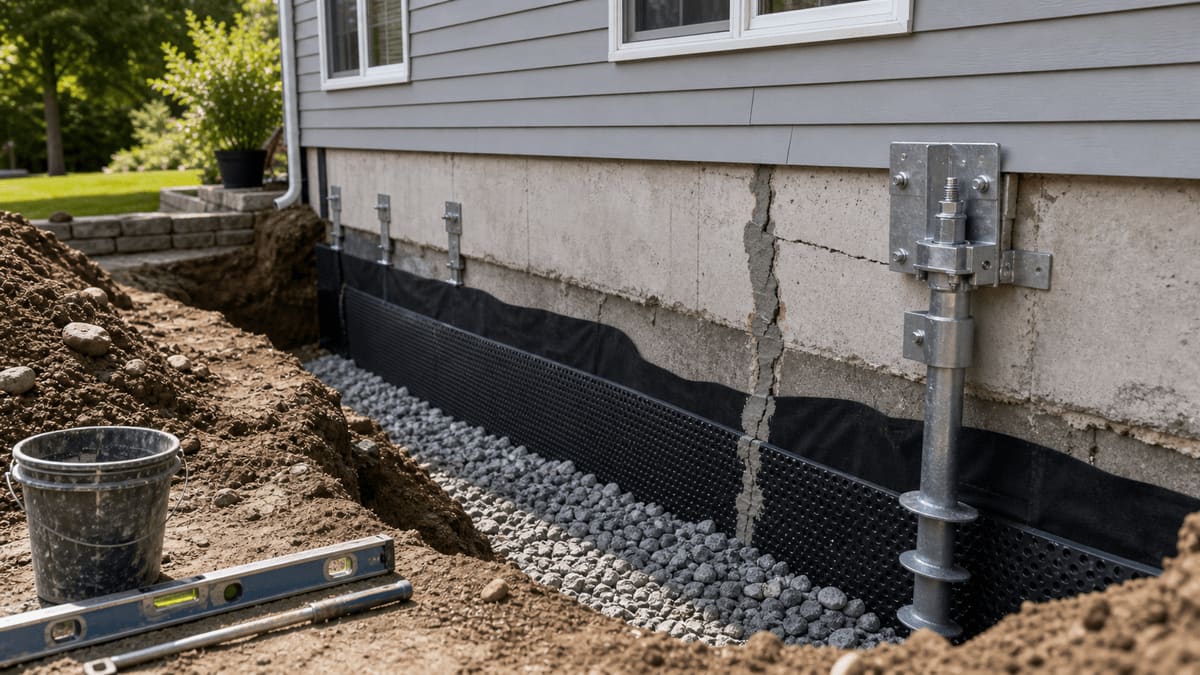
What drives your foundation repair cost
Foundation repair isn't one job — the price is set entirely by the diagnosis, which is why two homes on the same street can be $1,000 apart or $25,000 apart. The cheapest fixes are cosmetic-structural (sealing a crack); the expensive ones address active settlement or water:
- Hairline / non-structural cracks — epoxy or polyurethane injection, $400–$1,200 per crack.
- Active settlement — underpinning with 6–10 piers, $22,100–$39,200+ depending on pier type, count, and depth to load-bearing soil.
- Sunken slab — mudjacking or polyjacking, $500–$1,500 per spot.
- Bowing basement walls — carbon-fiber straps and wall anchors, $15,000–$26,800.
- Chronic water — interior drainage + sump $3,000–$8,000; full exterior waterproofing $5,000–$15,000+.
Steel push piers vs helical piers
For a settling foundation, the two underpinning methods price differently and suit different homes:
- Steel push piers — driven down using the weight of the house until they hit load-bearing strata or bedrock. Best for heavier structures (brick, two-story). Often the lower per-pier cost, but depth is unpredictable until driven.
- Helical piers — screwed into the soil like a giant auger. Better for lighter structures, porches, and tight-access sites, and they install faster with less disturbance. Usually a bit more per pier.
Either way, pier count is the real cost driver — a localized corner might need 4, a full side 10+. A contractor should map the settlement before quoting a number.
When to get a structural engineer first
A licensed structural engineer's report runs $1,176–$2,000 and is the single best money you can spend before a major repair. It sizes the fix, so you don't underpin a wall that only needed a crack sealed — or seal a crack that's actually a settling foundation. Call one before signing anything if you see: cracks wider than 1/4 inch, stair-step cracks in brick or block, doors and windows that suddenly stick, or floors that slope. Many reputable repair firms will credit an independent engineer's findings; be wary of any "free inspection" that only ever recommends its own most expensive product.
Frequently asked questions
How much does foundation repair cost in 2026?
Crack injection runs $400-$1,200 per crack in 2026. Steel/helical piering for settling: $1,000-$3,500 per pier (typical 6-10 piers = $22,100-$39,200+ installed). Bowed wall reinforcement: $15,000-$26,800. Full exterior waterproofing: $5,000-$15,000+.
How do I know if my foundation needs repair?
Signs include: cracks wider than 1/4 inch, doors/windows that stick, sloping floors, gaps at floor-wall joints, water intrusion, exterior brick step cracks, chimney separating from house. Get a structural engineer report ($500-$2,000) before paying for repair.
Steel piers vs helical piers?
Steel push piers are driven hydraulically to bedrock; best for heavy structures and deep settlement. Helical piers are screwed in like a ship's prop; faster install, better for lighter loads and additions. Helical typically $300-$700 more per pier.
Does insurance cover it?
Usually no — homeowner policies exclude settling. Exception: damage from sudden plumbing burst or named peril.
Lifetime warranty?
Most pier installers offer transferable lifetime warranty. Verify it transfers to a new owner if you sell.
How much does it cost to fix a foundation?
Minor crack repair runs $400-$1,200 per crack. Major settlement needs underpinning - 6-10 piers at $22,100-$39,200+. Bowing walls are $15,000-$26,800, and water-related fixes run $3,000-$15,000+. The diagnosis sets the price, so a structural engineer report ($1,176-$2,000) usually pays for itself.
Are steel piers or helical piers cheaper?
Steel push piers are often the lower per-pier cost and suit heavier two-story or brick homes; helical piers cost a bit more but install faster and work better for lighter structures and tight-access sites. Total cost is driven mostly by how many piers the settlement requires (typically 6-10).
Do I need a structural engineer for foundation repair?
For anything beyond a cosmetic crack - settling, bowing walls, sloping floors, sticking doors - yes. An independent engineer report ($1,176-$2,000) sizes the repair correctly and protects you from over-selling, which on a five-figure job pays for itself.