Garage Door Cost Calculator (2026)

Estimate the cost to install or replace a garage door. Pick door type, opener, demo, tracks, and electrical. 2026 data; not a contractor bid.

By Martin Lashgari, Ph.D., P.E., PMP · Last reviewed July 2026

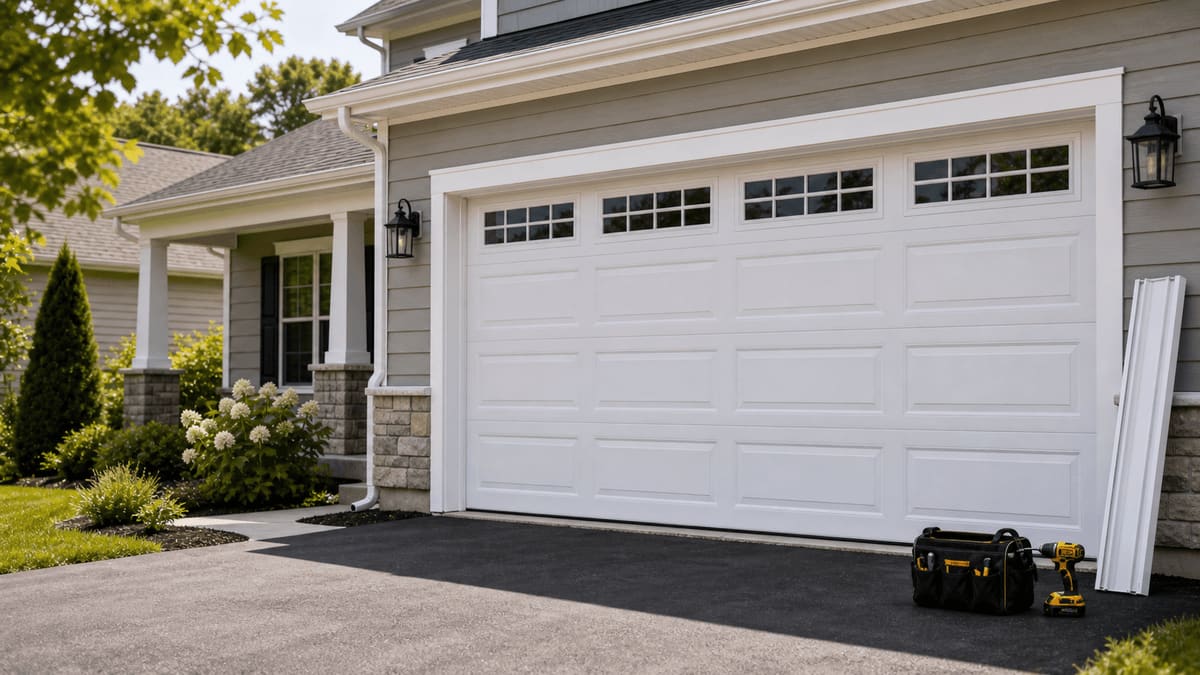
New white sectional residential garage door with carriage-house panels and a row of transom windows installed on a suburban home

Enter your garage door project

Includes labor, equipment, and contractor markup.

Common projects

Door & opener

Uses the first 3 digits as a planning zone (not exact local pricing). Overrides state average when matched.

Demo & add-ons

Your garage door estimate

Estimated installed range
Calculating…
Equipment
$0
Labor
$0
Per door
$0

Cost breakdown

Garage Door cost breakdown: quantity and estimated range for each line item
ItemQuantityEstimated range
Planning estimate, not a bid. 2026 ranges informed by manufacturer (Clopay, Amarr, Wayne Dalton, LiftMaster, Chamberlain), HomeGuide, HomeAdvisor, Homewyse.
What's not included: hurricane wind-rated reinforcement (FL HVHZ), garage flooring, weatherstripping replacement on jambs, custom finishes/staining for wood doors, and wall reinforcement for jackshaft openers.

Bid check

Got a garage door installer quote? Compare it to the planning range.

Quote
$0
Range check
Scope risk
Add a quote amount to compare it against the current estimate.

Methodology & sources

What this is: a planning-range garage door calculator informed by 2026 cost guides (HomeGuide, HomeAdvisor, Homewyse) and manufacturer pricing (Clopay, Amarr, Wayne Dalton, Haas, LiftMaster, Chamberlain, Genie).

Door pricing is per-door at standard sizes (single 8x7 / 9x7, double 16x7, double tall 16x8). Insulated and decorative styles add 50-200% over basic steel.

Labor is modeled from per-unit installed rates with a crew-rate sanity check ($55-$95/crew-hr loaded billing rate), informed by BLS OEWS 47-2031 (Carpenters). Single-car install ~3 crew-hours, double ~5.

Last updated: July 2026. Full methodology →

Helpful materials & tools for this project

A garage-door swap is the door, the hardware, and usually an opener:

  • Garage door & panels — Insulated or non-insulated, single or double.
  • Springs & hardware kit — Torsion springs, rollers, and track (a pro job for torsion).
  • Smart opener — Belt-drive openers with phone control.
  • Weather seal & bottom gasket — Seals the door against drafts and water.

Suggested materials to help you plan — not an endorsement, and never a contractor referral.

Cost simulator Monte Carlo simulation See the full range of likely costs — with the odds

For a typical double insulated steel, the installed planning band runs $4,657 to $7,987 nationally before regional adjustment.

What this project costs in different metros

Regional labor and material markets move the installed price. These bands come from the same engine as the calculator above, run at each metro's real cost multipliers — enter your ZIP in the calculator for a figure tuned to your exact area. National reference: $4,650–$8,000.

Garage Door typical installed cost by metro area, compared with the national reference
MetroTypical installed rangevs. national
San Francisco, CA$5,450–$9,350+17%
New York, NY$5,500–$9,450+18%
Boston, MA$5,100–$8,750+10%
Chicago, IL$5,150–$8,900+11%
Atlanta, GA$5,200–$8,950+12%
Houston, TX$4,900–$8,400+5%
Miami, FL$4,650–$8,0000%
Phoenix, AZ$4,750–$8,200+2%

Planning ranges, not contractor quotes. Multipliers are rounded regional planning indices (see methodology), not a reproduction of any proprietary cost table.

What moves this price the most

Vary one input across its full range while holding everything else at the typical scenario, and this is how far each choice can move the installed estimate — measured by running the calculator's own engine. The widest bars are where your decisions matter most; the figures show the cheapest-to-priciest span each input creates on its own.

  • Door type$1,700–$12,900
  • Reframe / structural header$6,300–$7,350
  • Extra remotes / keypads$6,100–$6,750
  • New tracks & springs$6,300–$6,850
  • Add 120V outlet for opener$6,300–$6,750
  • Opener$6,200–$6,500

A tornado view: each row varies a single input; a real project moves several at once, so totals aren't additive.

How much does a garage door cost in 2026?

Garage doors run $2,100 to $16,800 installed in 2026 depending on size, material, and opener. Steel is the value option; wood and glass are the top of market.

DoorDoor onlyDoor + installDoor + install + opener
Single steel basic$600-$1,000$2,100-$3,000$2,900-$4,400
Single steel insulated$1,200-$2,000$2,800-$4,300$3,600-$5,700
Double steel basic$900-$1,500$2,700-$4,100$3,400-$5,400
Single wood / composite$2,400-$4,000$4,200-$6,900$5,000-$8,300
Double steel insulated$2,100-$3,500$3,900-$6,600$4,700-$8,000
Double tall (16x8)$2,600-$4,500$4,800-$8,000$5,500-$9,300
Single glass / aluminum$2,900-$5,000$4,900-$8,200$5,600-$9,600
Double wood / carriage$4,700-$8,000$7,200-$12,500$7,900-$13,900
Double glass / aluminum modern$5,900-$10,000$8,700-$15,200$9,600-$16,800

Material and insulation: steel, wood, glass

  • Steel, basic ($588–$1,000 single) — the value default; durable and low-maintenance, can dent.
  • Steel, insulated ($1,176–$2,000 single) — same look, with an insulating core; quieter and more dent-resistant.
  • Wood / composite ($2,352–$4,000 single) — premium curb appeal; needs periodic refinishing.
  • Full-view glass / aluminum ($2,941–$5,000 single) — modern look, lets in light.

Double doors run roughly 1.5–2x the single price in the same material.

Is an insulated door worth it?

An insulated door ($1,176–$2,000 vs $588–$1,000 basic for a single) earns its premium when the garage is attached, has a room above it, doubles as a workshop, or sits in a hot or cold climate — it cuts the heat transfer that drives up the bills in adjacent spaces. Bonus: insulated doors are noticeably quieter and stiffer (more dent-resistant). For a detached, unconditioned garage you rarely heat, a basic door is the sensible call — don't pay for R-value you won't use.

Openers: chain vs belt vs direct-drive

  • Chain drive ($235–$400) — cheapest and reliable, but the loudest; fine for a detached garage.
  • Belt drive ($294–$500) — quiet; the right pick for an attached garage or a bedroom above.
  • Direct drive ($400–$700) — fewest moving parts, very quiet, long warranty.
  • Smart opener ($352–$600) — phone control and auto-close alerts (MyQ and similar).

Add a keypad/remote ($58–$100). If you're changing the door's size, budget reframing the opening ($588–$1,000).

Frequently asked questions

How much does a garage door cost in 2026?

$700-$13,000+ installed depending on size and material. Steel doors $700-$5,200; wood/composite $1,800-$10,700; glass/aluminum $2,600-$11,800. Add $300-$1,000 for an opener.

Insulated vs non-insulated?

Insulated costs 50-100% more, reduces noise, improves temperature, has better wind rating (R-12 to R-18 typical). Worth it for attached or workshop garages.

Belt vs chain vs direct drive opener?

Chain $300-$700 cheap+loud. Belt $400-$800 quiet, attached-garage friendly. Direct-drive/jackshaft $600-$1,000 quietest, ceiling-clearing.

How long does a garage door last?

Steel 15-30 yr. Wood 20-30 yr (with maintenance). Glass/aluminum 20-30 yr. Springs and openers usually need replacement well before the door (springs ~10-15 yr; openers ~12-15 yr).

Can I install a garage door myself?

Opener swaps are DIY-friendly. Full door installation is risky — torsion springs store enough energy to seriously injure or kill. Most homeowners hire pro for the door, DIY the opener.

Why does the calculator show a price range?

Brand, panel design, glass options, insulation rating, opener tier, and whether tracks/springs reuse all swing the total 30-60%. A range gives an honest planning estimate.

How much does a garage door cost?

A basic single steel door is $700-$1,700 installed, or $1,000-$2,400 with an opener. Insulated steel runs more; double doors roughly 1.5-2x the single price; wood and full-glass doors are $1,500-$5,400+ installed.

Are insulated garage doors worth it?

Yes if the garage is attached, has a room above, is used as a workshop, or sits in a hot/cold climate - the insulation cuts heat transfer to adjacent spaces, and the door is quieter and more dent-resistant. For a detached unheated garage, a basic door is fine.

Belt or chain garage door opener?

A belt-drive opener ($294-$500) is quiet - the right choice for an attached garage or a bedroom above. A chain drive ($235-$400) is cheaper and reliable but louder, which is fine for a detached garage.

Common mistakes & questions

  • Torsion springs are dangerous — store enough energy to seriously injure or kill; not a DIY job.
  • Spring/door weight match — spring rating must match door weight or motor will burn out.
  • Opener horsepower — 1/2 hp is fine for single, 3/4-1.25 hp for double or insulated.
  • Smart opener wifi range — many garages have weak signal; verify before buying.
  • Hurricane wind-rating — required in FL HVHZ counties and many coastal codes.
  • Ask your installer: spring rating, opener HP, wind rating (if applicable), warranty period, sensor placement.

When this estimate is wrong

  • The opener and its add-ons are separate from the door. A smart wifi opener, battery backup, and extra remotes or a keypad each add cost on top of the door itself.
  • Insulation and wind rating change the door price. An insulated door with a higher R-value, or a hurricane-rated door in a high-wind zone, costs more than a basic single-layer steel panel.
  • Worn hardware is easy to miss. Springs, rollers, and track wear out on their own cycle; reusing a tired spring with a new heavier door is a false economy, and new springs and track are their own line.
  • A powered opener needs a supported header and a dedicated outlet. If there's no ceiling outlet, an electrician has to run one, and a weak or missing header may need reinforcing.
  • Removing and hauling the old door and opener is labor plus a disposal fee, not part of the new-door price.
  • Changing the opening size is a structural job. Going wider or taller than the existing rough opening means reframing the header and jambs and usually a permit.
  • Most opener and door swaps need no permit, but a new opening or structural header does — check locally before assuming it's a same-day drop-in.