
Sidewalk Cost Calculator (2026)

Estimate the cost to pour a new concrete sidewalk or remove and replace an old one. Pick length, width, thickness, reinforcement, and finish, and we'll compute a planning range. 2026 data; not a contractor bid.

By Martin Lashgari, Ph.D., P.E., PMP · Last reviewed May 2026

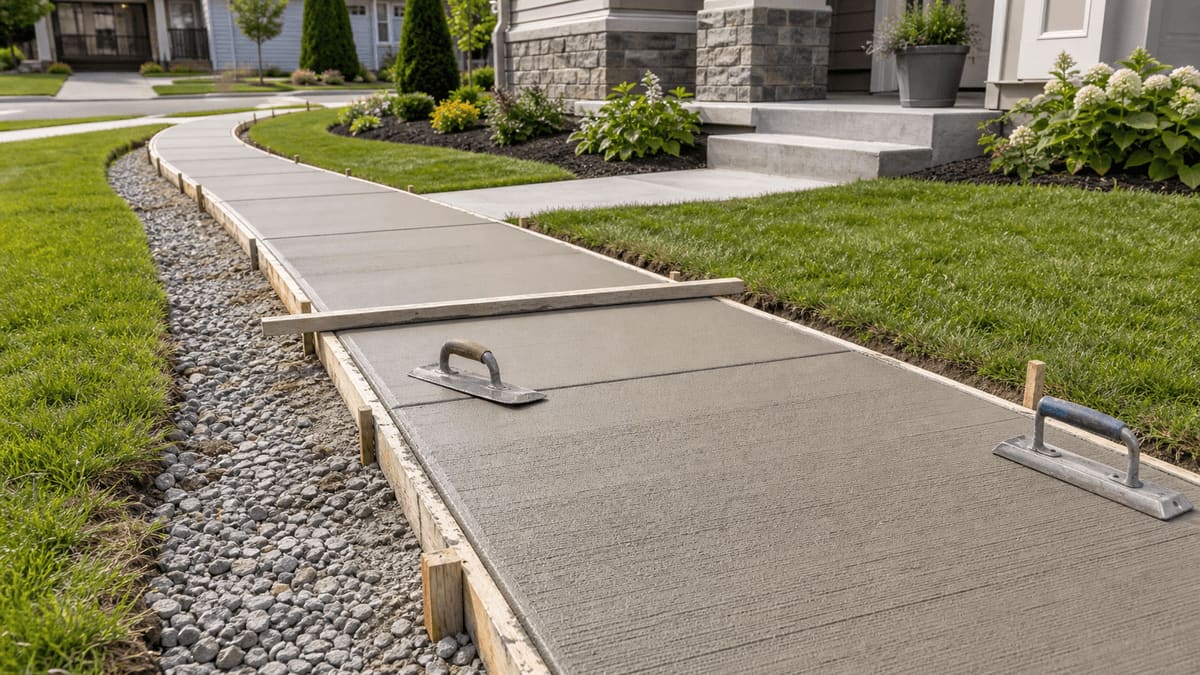
Fresh concrete sidewalk mid-installation with wood forms, broom finish, trowels, gravel base, lawn, and a suburban home entry

Enter your sidewalk project

Includes labor, equipment, contractor markup, and permits.

Common projects

Dimensions & scope

Standard residential sidewalk is 3-4 ft wide.
Total area160 sq ft

Reinforcement & finish

Location & permit

Uses the first 3 digits as a planning zone (not exact local pricing). Overrides state average when matched.

Your sidewalk estimate

Estimated installed range
Calculating…
Materials
$0
Labor
$0
Per sq ft
$0

Cost breakdown

ItemQuantityEstimated range
Planning estimate, not a bid. 2026 ranges informed by published cost guides (HomeGuide, Angi, ConcreteNetwork) and BLS regional wage data. Get 2-3 local quotes for accurate pricing.
What's not included: tree-root removal or grinding, drainage/grading corrections, retaining curbs, ADA ramp detectable-warning panels, utility relocation, and small-section repairs below a contractor's trade minimum.

Bid check

Got a contractor quote? Compare it to the planning range. No contact details collected.

Quote per sq ft
$0
Range check
Scope risk
Add a quote amount to compare it against the current estimate.

Methodology & sources

What this is: a planning-range sidewalk calculator informed by 2026 cost guides (HomeGuide, Angi, ConcreteNetwork), retail ready-mix pricing, and U.S. government wage data.

How it builds the estimate: concrete plus placement is priced per square foot by slab thickness, over a compacted gravel base. Reinforcement (fiber, wire mesh, or rebar) and a finish premium (broom, smooth, exposed aggregate, or stamped) are added per square foot. For remove-and-replace, demolition and disposal of the old slab are added. Labor covers forming, pouring, finishing, and saw-cut control joints.

Crew labor is a loaded billing rate informed by BLS OEWS occupation 47-4051 (Cement Masons & Concrete Finishers), then loaded with payroll burden, crew composition, equipment overhead, and contractor profit.

Engineer's note: small standalone sidewalks read higher per square foot than large pours because mobilization and trade minimums are spread over less area. For accurate pricing on a small section, expect a contractor minimum charge regardless of square footage.

Per-rate sources are stored in the underlying CSV with each row's source_url, source_date, region, and basis.

Last updated: May 2026. Full methodology →

How much does a concrete sidewalk cost in 2026?

A new concrete sidewalk runs $6 to $15 per square foot installed in 2026. Removing and replacing an existing walk runs $10 to $25 per square foot because demolition and disposal stack on top of the new pour. Small standalone sections cost more per square foot because of contractor trade minimums.

ProjectSizeNew installRemove & replace
Short walk (3×20)60 sf$600 – $1,300$900 – $1,900
Standard walk (4×40)160 sf$1,300 – $2,800$2,000 – $4,500
Long walk (4×80)320 sf$2,400 – $5,200$3,600 – $8,500
Driveway apron (12×6, 6 in)72 sf$1,000 – $2,200$1,500 – $3,400

What drives sidewalk cost

  • New vs. remove-and-replace — tearing out and hauling the old slab adds $3-$8 per square foot.
  • Thickness — a 6-inch slab for driveway crossings uses more concrete and usually rebar.
  • Finish — broom is standard; exposed aggregate and stamped/decorative add $3-$12 per square foot.
  • Reinforcement — fiber is cheapest; wire mesh and rebar add crack resistance and cost.
  • Access & size — small or hard-to-reach pours carry a higher per-square-foot rate due to minimums.
  • Permit — public right-of-way work usually needs a city permit and sometimes an approved contractor.

Common mistakes & questions

  • Skipping the compacted base — sidewalks heave and crack within a winter or two without a proper gravel sub-base.
  • No control joints — saw-cut or tooled joints every ~5 ft control where the slab cracks; skipping them guarantees random cracking.
  • Pouring too thin — 4 in minimum for walkways, 6 in where vehicles cross.
  • Ignoring slope — a slight cross-slope is needed for drainage and ADA compliance on public walks.
  • Forgetting the right-of-way permit — public-sidewalk work often requires a city permit and inspection.
  • Ask your contractor: base depth and compaction, slab thickness, reinforcement, control-joint spacing, and whether a permit is included.

When this estimate is wrong

  • Hard access (rural, no truck access, hand-carry concrete) adds 10-25%.
  • Trade minimums — small sections often hit a $400-$800 contractor minimum regardless of square footage.
  • Tree roots — grinding or removing roots that lifted the old walk adds cost.
  • Disposal fees — concrete dump fees vary widely by region.
  • Seasonality — cold-weather pours need blankets or admixtures and may cost more.
  • ADA upgrades — public-walk replacements may trigger ramp and detectable-warning requirements.