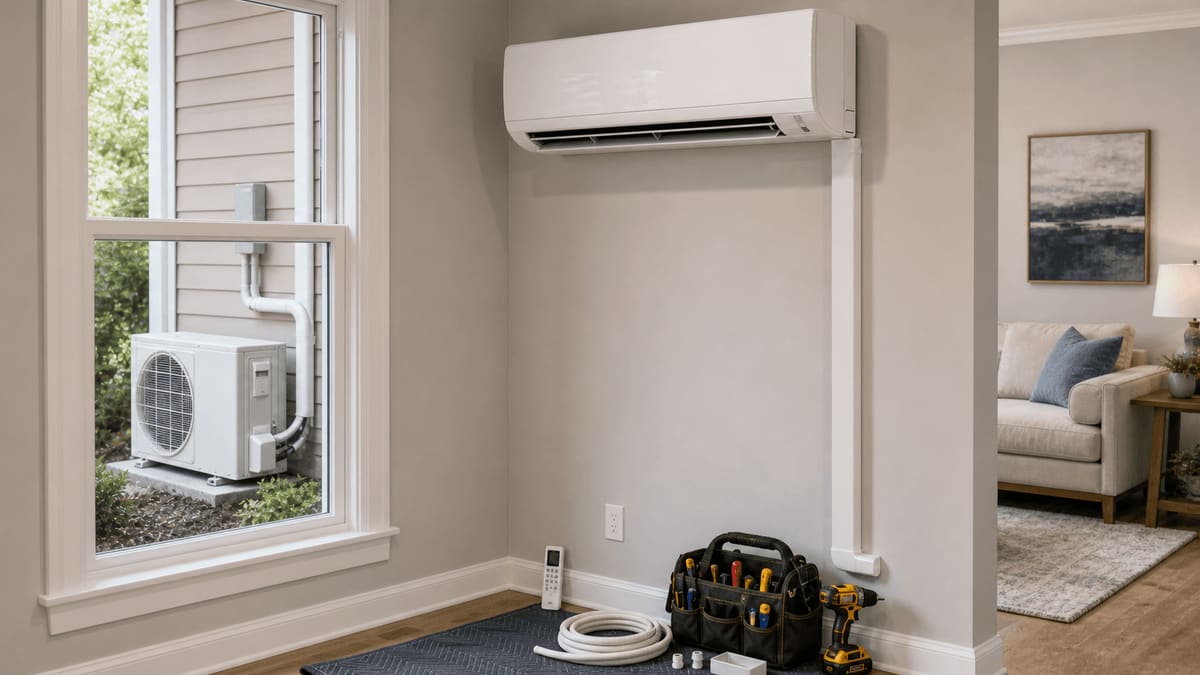
Mini-split cost by number of zones
A ductless system is priced by zones — each indoor head is one zone, fed by an outdoor condenser:
| Zones | Typical use | Installed |
|---|
| Single-zone (12k BTU) | One room or addition | $5,300 – $8,800 |
| 2-zone | Two rooms | $8,300 – $13,700 |
| 3-zone | A floor or small home | $11,200 – $18,200 |
| 4–5 zone | Whole home | $14,000 – $27,000+ |
Cold-climate "Hyper-Heat" units that hold capacity below freezing add roughly 30–50%.
Single-zone vs multi-zone, and head types
A single-zone system (one condenser, one head) is the efficient choice for a single room, a garage, an addition, or a primary suite. A multi-zone system runs 2–5 indoor heads off one outdoor condenser to cover a whole home. The indoor head style affects both look and price:
- Wall-mount ($350–$550) — the common, lowest-cost head.
- Ceiling cassette ($700–$1,050) — mounts flush in the ceiling for a hidden look.
- Floor console ($600–$900) — sits low on the wall, good under large windows.
Sizing and what drives the install
Size each head to the room by BTU — as a rough rule, 9k BTU suits ~350–400 sq ft, 12k ~500–550, 18k ~750–800, and 24k ~1,000–1,200 sq ft; a contractor's Manual J load calculation replaces that rule of thumb with a room-by-room estimate for your house. Beyond zone count, the install cost is driven by line-set length ($18–$28/ft of refrigerant line between condenser and head) and electrical: reusing an existing circuit ($200–$400) is cheapest, a new 240V circuit runs $700–$1,300, and a full sub-panel $1,500–$2,500 if your panel is full. Some DIY kits ship pre-charged with quick-connect line sets that their manufacturer designs to be installed without evacuation; for those, follow that manufacturer’s own commissioning and warranty steps. A conventional system needs the line set evacuated and the charge checked by an EPA 608-certified technician, which many warranties require.
FAQ
How much does a mini-split cost in 2026?
A single-zone 12k BTU system runs $5,300-$8,800 installed. Two-zone $8,300-$13,700. Three-zone $11,200-$18,200. Cold-climate Hyper-Heat units add 30-50%.
Mini-split vs central heat pump?
Mini-splits skip ductwork (saving $5K-$15K on installs) and zone-control efficiently, but each head costs visible wall space and multi-zone systems modulate worse than single-zones at low load.
Are federal tax credits still available for a mini-split?
The federal Section 25C energy-efficient home improvement credit applied for property placed in service on or before December 31, 2025. Projects placed in service in 2026 generally do not qualify under current IRS guidance — verify on IRS Form 5695 and the IRS Residential Clean Energy Credit page before relying on it.
How much does a mini-split cost per zone?
A single-zone 12k BTU system runs $5,300-$8,800 installed; each added zone roughly adds $700-$1,100 in install labor plus the head and condenser capacity. A 3-zone system runs about $11,200-$18,200.
What size mini-split do I need?
As a rule of thumb, 9k BTU covers ~350-400 sq ft, 12k ~500-550, 18k ~750-800, and 24k ~1,000-1,200 sq ft per head. A contractor should run a Manual J load calculation, a room-by-room estimate of the heating and cooling your house needs, rather than guessing.
Can you heat a whole house with mini-splits?
Yes - a multi-zone system runs up to 4-5 indoor heads off one condenser, typically $14,000-$27,000+ for a whole home. In cold regions, choose cold-climate "Hyper-Heat" units that maintain capacity below freezing.
More questions
Do I need a permit for a mini-split?
Yes in most jurisdictions — the driver is the electrical work. A mini-split needs a dedicated 240V circuit and an outdoor disconnect at the condenser, so an electrical (and often a mechanical) permit and inspection apply even though no ductwork is involved. Your local building department confirms which permits your zone count and circuit change require.
Can I install a mini-split myself?
Mostly not, and it depends on the system. A conventional flare-connected mini-split needs refrigerant work: handling refrigerant legally requires EPA Section 608 certification, and the line set has to be evacuated and the charge verified by someone equipped to do it. A small class of pre-charged quick-connect kits is designed and warrantied to be installed without evacuation — for those, follow that manufacturer’s own commissioning and warranty steps rather than the conventional procedure. Either way, the dedicated 240V circuit and disconnect are electrical work that usually needs a licensed electrician and a permit.
How far can the condenser sit from the indoor head?
Most manufacturers cap the refrigerant line-set at roughly 100–165 ft total and limit the vertical rise (lift) between the condenser and head, commonly around 50–65 ft. Longer runs lose capacity and may need additional refrigerant added by weight; the factory pre-charge only covers a set line length (often the first 15–25 ft), so plan the condenser location before ordering.
Where does the condensate go?
Each indoor head produces condensate that drains by gravity through a small line, usually routed outside or to a nearby drain. Wall-mounted heads on an interior wall, or any head below the drain point, need a small condensate pump. A clogged or improperly pitched drain line is the most common cause of a mini-split leaking water down the wall.
What warranty comes with a mini-split?
Two separate warranties. The manufacturer covers parts — commonly 5–10 years on components and 7–12 years on the compressor, but usually only if a licensed installer commissioned the unit and you register it. The installer's labor warranty (often 1–2 years) is separate and covers the workmanship, not the equipment. Confirm both in writing.
Should I oversize to be safe?
No. An oversized mini-split short-cycles — it satisfies the thermostat fast, then shuts off before it dehumidifies, leaving the room clammy and wearing the compressor. Inverter systems are most efficient running steadily near their rated load, so size each head to an ACCA Manual J calculation for the actual room rather than rounding up.