Sprinkler / Irrigation Cost Calculator (2026)

Estimate the cost of a sprinkler or drip irrigation system. Pick zone count, heads, controller, and backflow. 2026 data; not a contractor bid.

By Martin Lashgari, Ph.D., P.E., PMP · Last reviewed June 2026

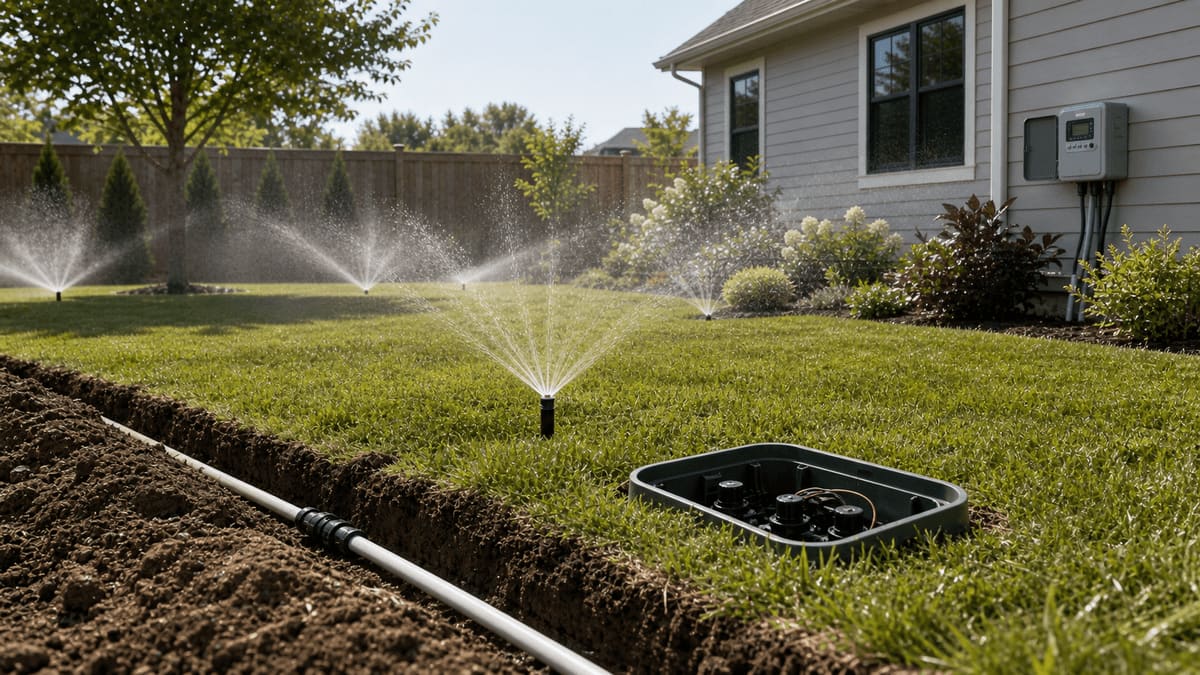
In-ground lawn sprinkler system mid-installation with active rotor heads, an open valve box, exposed PVC supply line, and a wall-mounted controller

Enter your irrigation project

Includes labor, equipment, permit, and contractor markup.

Common projects

Zones & heads

Rule of thumb: 1 zone per 1,500-2,500 sf of lawn.
Uses the first 3 digits as a planning zone (not exact local pricing). Overrides state average when matched.
Typical 6-10 for spray, 4-6 for rotor. Set 0 for drip.
Avg ~80 lf per zone.

Controller & backflow

Your sprinkler estimate

Estimated installed range
Calculating…
Materials
$0
Labor
$0
Per zone
$0

Cost breakdown

ItemQuantityEstimated range
Planning estimate, not a bid. 2026 ranges informed by EPA WaterSense, manufacturer (Hunter, Rain Bird, Rachio, Hydrawise) MSRP, HomeGuide, HomeAdvisor, Homewyse.
What's not included: water-meter upsizing, dedicated irrigation meter (saves on sewer fee), pressure-reducing valve for high-pressure homes, hardscape boring (under driveway), annual backflow inspection, plant-specific drip emitter design.

Bid check

Got an irrigation contractor quote? Compare it to the planning range.

Quote per zone
$0
Range check
Scope risk
Add a quote amount to compare it against the current estimate.

Methodology & sources

What this is: a planning-range irrigation calculator informed by EPA WaterSense, manufacturer MSRP (Hunter, Rain Bird, Toro, Rachio, Hydrawise), and HomeGuide/HomeAdvisor cost data.

Crew labor is a loaded billing rate ($55-$95/crew-hr) for irrigation crews + plumbers (for backflow taps).

Last updated: May 2026. Full methodology →

Cost simulator Monte Carlo simulation See the full range of likely costs — with the odds

How much does irrigation cost in 2026?

System sizeZonesRange
Small lot2 zones$1,500-$4,000
Medium yard (1/4 acre)4 zones$2,500-$8,000
Large yard (1/2 acre)8 zones$6,000-$14,000
Drip-only garden3 zones$1,500-$4,500

What drives sprinkler system cost

An irrigation system is priced by the zone — a group of heads run by one valve. Each zone adds a valve, wiring, trenching, and heads, which is why a 2-zone small lot ($1,500–$4,000) and an 8-zone large yard ($6,000–$14,000) scale roughly with zone count. The big line items per zone: trenching ($3–$5 per linear foot), the valve ($44–$75), zone install labor ($294–$500), and the heads themselves.

Spray vs rotor vs drip heads

  • Spray heads ($5–$8 each) — fixed fan pattern, short throw, best for small or oddly-shaped lawn areas. You need more of them per area.
  • Rotor heads ($12–$20 each) — rotating stream, long throw, cover large open lawns with fewer heads — usually the cheaper way to water a big yard despite the higher per-head price.
  • Drip zones ($24–$40 per zone) — deliver water directly to plant roots in beds and gardens; the most water-efficient option and ideal for foundation plantings and vegetable beds.

Smart controllers, backflow, and what saves money long-term

The controller is a small line item with a big operating-cost impact. A basic timer runs $117–$200; a smart Wi-Fi controller ($294–$500) adjusts watering to local weather and soil and can cut water use 20–50% — many water utilities offer rebates that offset much of the difference. A backflow preventer ($235–$400 installed) is almost always code-required to keep irrigation water from siphoning back into your drinking supply. In freeze climates, budget annual winterization ($117–$200) to blow out the lines — a cracked main from skipping it costs far more.

Frequently asked questions

How much does a sprinkler system cost in 2026?

Residential sprinkler systems run $2,500-$8,000 for a typical 1/4 acre yard with 4 zones. Small (2-zone) lots: $1,500-$4,000. Large (8-zone) properties: $6,000-$14,000. Smart wifi controllers add $200-$500 vs basic timers.

How many zones do I need?

Zones group plants with similar water needs. Rule of thumb: 1 zone per 1,500-2,500 sf of lawn. A 1/4 acre (~10,000 sf) yard typically needs 4 zones. Drip irrigation is separately zoned from spray for plant beds.

Do I need a backflow preventer?

Yes — almost every jurisdiction requires a reduced-pressure backflow preventer (RPZ) on irrigation systems to protect drinking water. Annual testing is also required in most states. RPZ install $350-$900 including plumber tap.

Smart vs basic controller?

Smart wifi controllers (Rachio/Hydrawise) save 30-50% on water by skipping rain days; pay back in 1-2 yr in dry climates.

Can I DIY?

Yes for the trenching + heads + valves with rented trencher ($75-$150/day). Backflow tap usually needs a licensed plumber.

How much does it cost to install a sprinkler system?

About $1,500-$4,000 for a small 2-zone lot, $2,500-$8,000 for a 1/4-acre 4-zone yard, and $6,000-$14,000 for a 1/2-acre 8-zone system. Cost scales mainly with the number of zones.

How much does each sprinkler zone cost?

Roughly $300-$500 in install labor per zone plus the valve ($44-$75), trenching ($3-$5 per foot), and heads ($5-$40 each depending on spray, rotor, or drip). Zone count is the single biggest driver of total system price.

Are smart sprinkler controllers worth it?

Usually yes. A smart Wi-Fi controller ($294-$500) costs more than a basic timer ($117-$200) but adjusts to weather and can cut water use 20-50%, and many utilities offer rebates that close the gap. The savings compound every season.
Common mistakes & questions

  • Skip 811 utility marking before trenching.
  • Match precipitation rate (PR) within zones — mixing spray and rotor in one zone wastes water.
  • Skip the rain sensor — saves 30-50% water annually for $50-$150 installed.
  • Forget winterization in cold climates — frozen lines crack pipes; $75-$200/yr blow-out service.
  • Skip pressure check — high-pressure homes (>80 psi) need PRV or heads will mist instead of throw.
  • Underground utilities (gas, electric, cable) can be cut by trenchers.
  • Ask your installer: head spacing diagram, PR matching, controller wifi range, backflow test schedule, winterization plan.

When this estimate is wrong

  • Hardscape boring (driveway, walkway) adds $200-$500/cross.
  • Trenching in rocky soil is 30-50% slower.
  • Drought-zone code (CA, AZ, NV) requires WaterSense certification.
  • HOA review can add 1-2 weeks.
  • Backflow inspector backlog in some markets.