Drywall Cost Calculator (2026)

Estimate sheets, mud, tape, screws, and labor for drywall by room size, ceiling height, and finish level. 2026 data; not a contractor bid.

By Martin Lashgari, Ph.D., P.E., PMP · Last reviewed July 2026

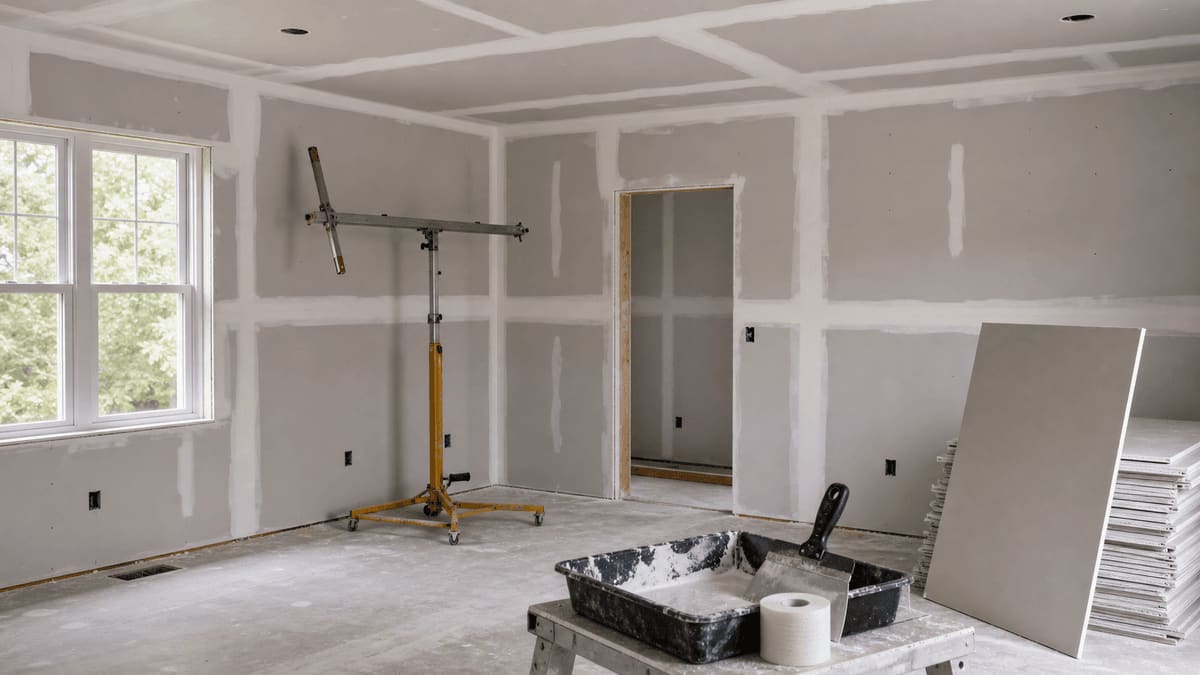
Interior room with taped and mudded drywall seams, a drywall lift, joint compound pan, and a stack of sheetrock ready for finishing

Enter your drywall project

Includes labor, equipment, and contractor markup. Most drywall jobs do not need a permit.

Common projects

Room dimensions

Material & site

Uses the first 3 digits as a planning zone (not exact local pricing). Overrides state average when matched.

Your drywall estimate

Estimated installed range
Calculating…
Materials
$0
Labor
$0
Per sq ft
$0

Cost breakdown

Drywall cost breakdown: quantity and estimated range for each line item
ItemQuantityEstimated range
Planning estimate, not a bid. 2026 ranges informed by HomeGuide, Angi, Homewyse.
What's not included: framing repair, insulation, electrical roughs, plumbing roughs, primer (use the paint calculator), and final paint.

Bid check

Got a drywall contractor quote? Compare it to the planning range.

Quote per sq ft
$0
Range check
Scope risk
Add a quote amount to compare it against the current estimate.

Methodology & sources

What this is: a planning-range drywall calculator informed by 2026 cost guides (HomeGuide, Angi, Homewyse).

Sheet count auto-computed from wall + ceiling area divided by sheet size (32 sf for 4x8, 48 sf for 4x12), plus a 10% waste factor.

Mud, tape, screws auto-quantified from total area: 1 bucket per ~300 sf taped joints, 1 roll per ~1,500 sf, 1 box of screws per ~400 sf.

Labor is modeled from per-unit installed rates with a crew-rate sanity check ($55-$100/crew-hr loaded billing rate), informed by BLS OEWS 47-2081 (Drywall Installers).

Last updated: July 2026. Full methodology →

Helpful materials & tools for this project

Drywall is the boards plus the mud, tape, and fasteners to finish them:

  • Drywall sheets — 1/2 in standard or 5/8 in for ceilings and fire-rated walls.
  • Joint compound & tape — Mud and paper or mesh tape for the seams.
  • Drywall screws — Coarse-thread for wood, fine for metal studs.
  • Taping knives & sanding pole — The finishing tools.

Suggested materials to help you plan — not an endorsement, and never a contractor referral.

Cost simulator Monte Carlo simulation See the full range of likely costs — with the odds

For a typical 16x16 living room, the installed planning band runs $3,201 to $5,171 nationally before regional adjustment.

What this project costs in different metros

Regional labor and material markets move the installed price. These bands come from the same engine as the calculator above, run at each metro's real cost multipliers — enter your ZIP in the calculator for a figure tuned to your exact area. National reference: $3,200–$5,150.

Drywall typical installed cost by metro area, compared with the national reference
MetroTypical installed rangevs. national
San Francisco, CA$4,450–$7,300+40%
New York, NY$4,550–$7,500+44%
Boston, MA$3,800–$6,150+19%
Chicago, IL$4,200–$6,850+32%
Atlanta, GA$4,000–$6,550+26%
Houston, TX$3,650–$5,900+14%
Miami, FL$3,200–$5,1500%
Phoenix, AZ$3,400–$5,550+7%

Planning ranges, not contractor quotes. Multipliers are rounded regional planning indices (see methodology), not a reproduction of any proprietary cost table.

What moves this price the most

Vary one input across its full range while holding everything else at the typical scenario, and this is how far each choice can move the installed estimate — measured by running the calculator's own engine. The widest bars are where your decisions matter most; the figures show the cheapest-to-priciest span each input creates on its own.

  • Length (ft)$2,450–$10,550
  • Width (ft)$2,450–$10,550
  • Wall height (ft)$3,600–$5,600
  • Include ceiling?$3,100–$4,200
  • Existing drywall removal?$4,200–$4,800
  • Add texture?$3,700–$4,200

A tornado view: each row varies a single input; a real project moves several at once, so totals aren't additive.

How much does drywall cost in 2026?

Drywall installation runs $3.50 to $6.50 per square foot in 2026 ($110-$210 per 4x8 panel installed). Material is small (~25%); labor is most of the cost (65-75%).

ProjectTotal areaSheetsInstalled cost
12x12 single room (walls + ceiling, 8 ft)~528 sf~18$2,100 – $3,400
16x16 living room (9 ft walls + ceiling)~832 sf~22 (4x12)$3,200 – $5,200
Basement 24x36 (8 ft walls + ceiling)~1,824 sf~50 (4x12)$6,400 – $10,500
20x22 garage (5/8 fire-rated)~1,112 sf~38$4,300 – $7,000

Drywall finish levels (Level 0-5)

  • Level 0 — raw drywall, no finish. Utility spaces only.
  • Level 1 — one tape coat. Inside concealed areas.
  • Level 2 — tape + 2 coats over fasteners. Garages, warehouses.
  • Level 3 — 3 coats. Pre-texture standard.
  • Level 4 — standard residential finish. Ready for flat or eggshell paint.
  • Level 5 — skim coat. Required under semi-gloss/gloss paint or critical lighting (raking light).

Frequently asked questions

How much does drywall cost in 2026?

Drywall installation runs $3.50-$6.50 per square foot in 2026, or $110-$210 per 4x8 panel installed. A 12x12 room with walls + ceiling runs $2,100-$3,400 installed.

How many sheets of drywall do I need?

A standard 4x8 sheet covers 32 sq ft. Total wall area = perimeter (ft) x height (ft). Add ceiling area if applicable, then divide by 32 (or 48 for 4x12) and add 10% waste.

What are drywall finish levels?

Level 0: unfinished. Level 1: tape coat only (utility spaces). Level 2: 2 coats over tape. Level 3: 3 coats, ready for heavy texture. Level 4: standard residential finish, ready for paint. Level 5: skim coat for premium smooth finish under glossy paint.

What's the difference between drywall and sheetrock?

Same product. "Sheetrock" is a brand name (USG); "drywall" is the generic term. Used interchangeably in the industry.

Can I DIY drywall?

Hanging is doable for a careful DIYer; taping and finishing is the harder skill. Plan to spend 2-3x as long as a pro and the finish quality will be lower. DIY can save 40-60% on labor.

What's the difference between Level 4 and Level 5?

Level 4 has 3 coats over tape, sanded smooth, ready for paint — standard residential finish. Level 5 adds a skim coat over the entire surface, eliminating any visible texture differences. Required under semi-gloss/gloss paint or in rooms with raking light.

Why does the calculator show a price range?

Drywall labor varies 30-50% by region, contractor experience, and finish level. A range gives an honest planning estimate.

Common mistakes & questions

  • Wrong finish level — Level 4 is standard for paint; Level 5 (skim coat) is required only for raking light or high-gloss paint.
  • Skip vapor barrier in cold climates — interior side in IECC 5+; not needed in 1-3.
  • Wrong screw pattern — 12 in on field, 8 in on edges; loose screws pop within 1-2 yr.
  • Forget control joints in long runs — every 30 ft on walls, 50 ft on ceilings.
  • Ask your contractor: finish level, screw pattern, corner bead type, prime coat plan.

When this estimate is wrong

  • Finish level changes the labor more than the material. A Level 5 skim coat, which is what you want under raking light or gloss paint, is meaningfully more finishing time than a standard Level 4.
  • Ceilings cost more than walls. Hanging and finishing overhead is slower and harder on labor than the same square footage on a wall.
  • Texture is a two-way cost. Adding knockdown or orange-peel is extra work, and matching existing texture on a patch or a partial wall is harder still to blend invisibly.
  • High walls and open stairwells need staging. Anything above a normal 8-foot reach means scaffolding or planks, which slows both hanging and finishing.
  • Removing old board can expose surprises. Moisture, mold, or a plumbing or wiring issue found behind the drywall becomes its own repair before new board goes up.
  • An open wall is the moment for insulation and vapor work. If cavities are exposed, air-sealing or adding insulation is far cheaper now than after the wall is closed — worth pricing in.
  • Corner bead, archways, and lots of inside corners add finishing detail that flat wall area alone doesn't capture.