Tree Removal Cost Calculator (2026)

Estimate the cost to remove a tree. Pick size, access, and stump treatment. 2026 data; not a contractor bid.

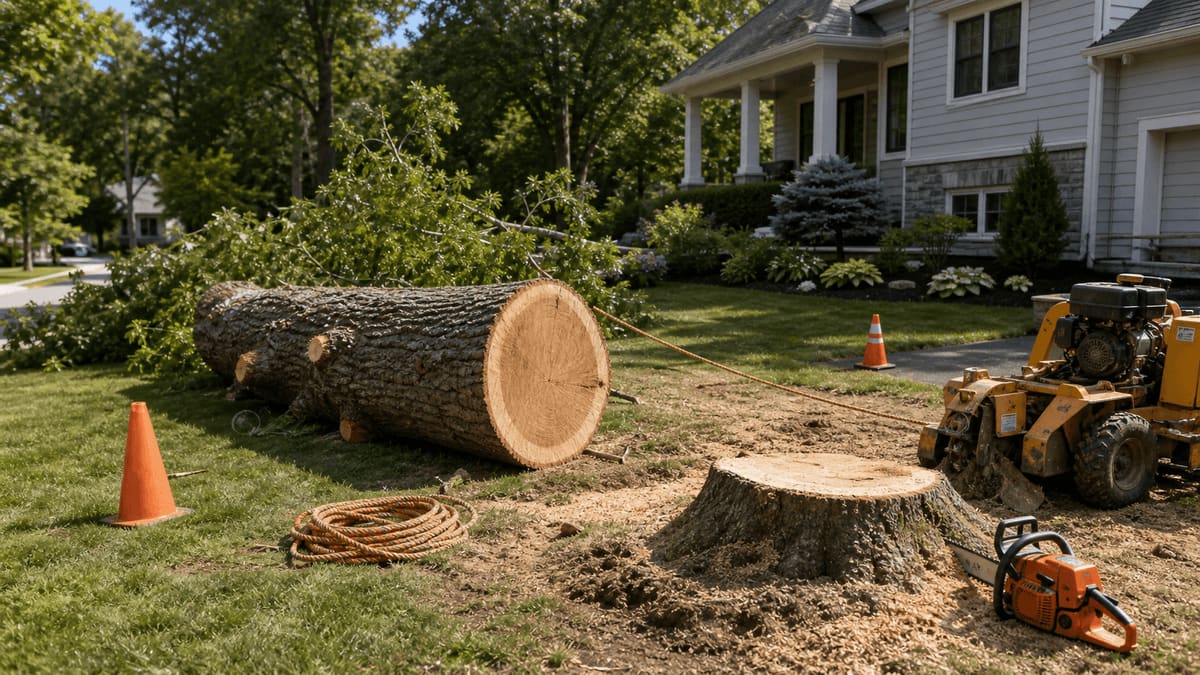
Large hardwood tree felled in sections on a residential lawn with a fresh-cut stump, stump grinder, chainsaw, rope, and safety cones

Enter your tree project

Includes labor, equipment, and contractor markup. ISA Certified Arborist recommended.

Common projects

Tree count & size

Easy: a truck reaches the drop zone. Difficult: a tight yard or work over a fence. Crane: over the house or power lines.

Add-ons

Your tree removal estimate

Estimated installed range
Calculating…
—
Materials
$0
Labor
$0
Per tree
$0

Cost breakdown

Tree Removal cost breakdown: quantity and estimated range for each line item
ItemQuantityEstimated range
Planning estimate, not a bid. 2026 rates on this page cite HomeGuide (13 rows), BLS wage data (1) and USDA Forest Service (1). 5 rate rows are internal estimates with no public source yet. Compare written bids on an identical scope for accurate local pricing.
What's not included: tree replanting, replacement landscaping, structural damage repair from fallen branches, lightning-damaged trees with internal hazards, tree that is mostly dead requiring extra precautions.

Bid check

Got an arborist quote? Compare it to the planning range.

Not sure and Whole estimate compare with the whole estimate. Materials + equipment uses those lines alone, without labor lines or markup; items priced as installed work are left out and the result names them.
Quote
—
Range check
—
Scope risk
—
Add a quote amount to compare it against the current estimate.

Methodology & sources

What this is: a planning-range tree removal calculator. Its rates cite HomeGuide, BLS wage data and USDA Forest Service, and 5 rows are internal estimates. The note under the estimate counts the rows from each source.

Labor is priced from per-unit installed rates, not by the hour. For reference, the rate file also lists a loaded crew rate ($88-$150 per crew-hour) built on BLS OEWS 37-3013 (Tree Trimmers and Pruners). Higher than other trades due to specialized risk + crane operator + insurance.

Last updated: November 2026. Full methodology →

Helpful materials & tools for this project

Tree removal is a hire-out job for anything large, but cleanup gear is worth owning:

  • Chainsaw & bar oil — For limbing and bucking downed sections.
  • Safety gear — Helmet, chaps, and gloves — non-negotiable for saw work.
  • Stump-grinder rental — Cheaper than a service if you do the grinding yourself.

Suggested materials to help you plan — not an endorsement, and never a contractor referral.

Cost simulator

Monte Carlo simulation

See the full range of likely costs — with the odds

For a typical storm-damage emergency, the installed planning band runs $2,676 to $4,744 nationally before regional adjustment.

What this project costs in different metros

Regional labor and material markets move the installed price. These bands come from the same engine as the calculator above, run at each metro's planning multipliers — enter your ZIP in the calculator for a figure tuned to your area. National reference: $2,700–$4,750.

Tree Removal typical installed cost by metro area, compared with the national reference
MetroTypical installed rangevs. national
San Francisco, CA$3,950–$7,050+48%
New York, NY$4,100–$7,250+52%
Boston, MA$3,250–$5,750+22%
Chicago, IL$3,700–$6,600+39%
Atlanta, GA$3,500–$6,200+30%
Houston, TX$3,150–$5,550+17%
Miami, FL$2,550–$4,550-4%
Phoenix, AZ$2,900–$5,150+9%

Planning ranges, not contractor quotes. Multipliers are rounded regional planning indices (see methodology), not a reproduction of any proprietary cost table.

What moves this price the most

Vary one input across its full range while holding everything else at the typical scenario, and this is how far each choice can move the installed estimate — measured by running the calculator's own engine. The widest bars are where your decisions matter most; the figures show the cheapest-to-priciest span each input creates on its own.

  • Number of trees$3,700–$42,400
  • Tree size class$3,200–$6,250
  • Access difficulty$3,200–$5,750
  • Trunk diameter (DBH, in)$3,700–$5,900
  • Proximity to structure / power$3,350–$4,600
  • Emergency / storm call-out$2,900–$3,700

A tornado view: each row varies a single input; a real project moves several at once, so totals aren't additive.

How much does tree removal cost in 2026?

Five modeled examples from this calculator’s presets, at national prices: one tree each, with an 18-inch trunk, near the house or fence. They are planning examples, not calibrated market quotes; the publisher averages in the next table run lower.

ExampleAlso includesModeled range
Small tree, under 30 ft, easy accessstump grinding, haul-off$1,600-$2,800
Medium tree, 30-60 ft, easy access (the default)stump grinding, haul-off$1,900-$3,400
Large tree, 60-80 ft, difficult accessstump grinding, haul-off$3,000-$5,400
XL tree, 80+ ft, removed with a cranestump grinding, haul-off, a permit$5,700-$10,200
Storm-damage call-out, medium tree, difficult accessemergency premium, haul-off, no stump work$2,700-$4,700

Every example also carries the calculator’s mobilization charge, a crew-trip and chipper charge, and a charge for working near the house or fence. The XL example’s crane is already included; do not add a crane charge to it.

Sizing your tree (the main cost driver)

Removal is priced by height band, because height tracks trunk diameter, canopy, and how long the crew spends in it. HomeGuide (February 2026) publishes these average removal costs by height:

SizeHeightHomeGuide average removal cost
Smallunder 30 ft$200 – $500
Medium30–60 ft$500 – $1,500
Large60–80 ft$850 – $2,000
XL80+ ft$1,200 – $2,500+

These are the publisher’s averages, not this calculator’s results, and HomeGuide does not itemise what they include. This calculator’s examples above also carry a mobilization charge, a crew-trip and chipper charge, a near-house charge and usually stump grinding and haul-off, which is part of why they run higher.

Quick height check: on a sunny day, measure the tree's shadow and your own shadow, then multiply the tree's shadow by (your height ÷ your shadow).

Access is the hidden multiplier

Two identical oaks can differ by thousands based purely on what's underneath them. A tree with a clear drop zone can be felled in pieces quickly. A tree leaning over the house, power lines, a pool, or a neighbor's fence has to be rigged down limb by limb — difficult-access work adds $294–$500 per tree, and when a crane is the only safe option it adds $1,470–$2,500 per tree, sometimes exceeding the removal itself. An emergency or storm-damage call-out adds a $470–$800 premium per call-out, once for the job however many trees it covers. All three are this calculator’s rates before location and contractor markup.

Stump: grind or fully remove?

Removal quotes usually stop at the stump — dealing with it is a separate line. Stump grinding ($176–$300 per stump) chews the stump 4–12 inches below grade and is enough for most lawns; the roots stay and decay over time. Full stump removal ($470–$800 per stump) excavates the root ball and is what you want if you're replanting in the same spot or building over it. Add haul-off of the wood (about $120–$200 per tree) unless you want it left as firewood or chips. These are rates before location and contractor markup.

Frequently asked questions

How much does tree removal cost in 2026?

HomeGuide (February 2026) lists average removal costs of $200-$500 for small trees under 30 ft, $500-$1,500 for 30-60 ft, $850-$2,000 for 60-80 ft and $1,200-$2,500+ for trees over 80 ft. This calculator's default job, one medium tree near the house with stump grinding and haul-off, is about $1,900-$3,400 at national prices. A crane, when one is needed, is priced at $1,470-$2,500 per tree before markup.

Stump grinding vs full removal?

Stump grinding ($176-$300 per stump before markup) takes the stump 4-12 inches below grade — fine for lawn replanting. Full stump removal ($470-$800 per stump before markup) includes the root ball — required if you're building over the spot.

Do I need a permit to remove a tree?

Most private-property trees don't require permits. But heritage/protected species (oaks in some CA counties, live oaks in TX, certain species in HI), trees in public right-of-way, and trees over a certain DBH (diameter at breast height) often need permits. Check local code.

Can I DIY?

Small trees (under 20 ft, away from structures, with proper PPE) maybe. Medium+ trees, near structures, or with chainsaw inexperience: hire pro. Tree work kills 100+ workers/yr; homeowner DIY accidents are common.

Who pays if tree is on property line?

Usually whoever owns the trunk. State law varies. Document with photos and surveyor before removing.

How much does it cost to remove a large tree?

HomeGuide (February 2026) lists average removal costs of $850-$2,000 for a 60-80 ft tree and $1,200-$2,500+ for one over 80 ft. In this calculator, a 60-80 ft tree with difficult access, stump grinding and haul-off is about $3,000-$5,400. An XL tree that needs a crane, near the house, with stump grinding, haul-off and a permit is about $5,700-$10,200; the crane is already included. For other jobs, stump grinding is priced at $176-$300 and full stump removal at $470-$800 per stump, before markup.

Does tree removal include the stump?

Usually not - the stump is a separate line. Grinding it 4-12 inches below grade is priced at $176-$300 per stump before markup; fully excavating the root ball (needed if you will replant or build there) is $470-$800.

Why does removing a tree near my house cost more?

Access. A tree over your roof, power lines, or fence must be rigged down piece by piece rather than felled. Difficult access adds $294-$500 per tree, and a crane - sometimes the only safe option - adds $1,470-$2,500, both before markup.

Common mistakes & questions

  • Verify insurance — uninsured tree work means you're liable for any damage / injury.
  • Check ISA certification — arborist credentialing.
  • Get the haul-off in writing — this calculator prices brush and log haul-off at about $120-$200 per tree before markup; if a quote leaves it out, clearing the brush becomes a separate job.
  • Skip "topping" requests — bad for tree health if you're keeping it; doesn't reduce removal cost.
  • Stump-grinding leaves a chip mound — plan for fill / lawn restore.
  • Check for nesting birds during spring (Migratory Bird Treaty Act).
  • Ask your arborist: insurance certificate, ISA cert, drop-zone protection, haul-off included, stump treatment, permit pulled.

When this estimate is wrong

  • Near power lines — choose “Near power lines” in the calculator, which adds $700-$1,250 per tree before location and markup. Coordination with the utility is still required and is arranged separately; it is not priced here.
  • Hazard tree (dead / leaning / split) = riggers + bigger team.
  • Multiple trees discount possible — bundle if you have 2+.
  • Storm-season demand (after hurricanes / ice storms) doubles prices.
  • Heritage species permit + replanting requirement.
  • Crane availability backlog 1-3 wk in some markets.