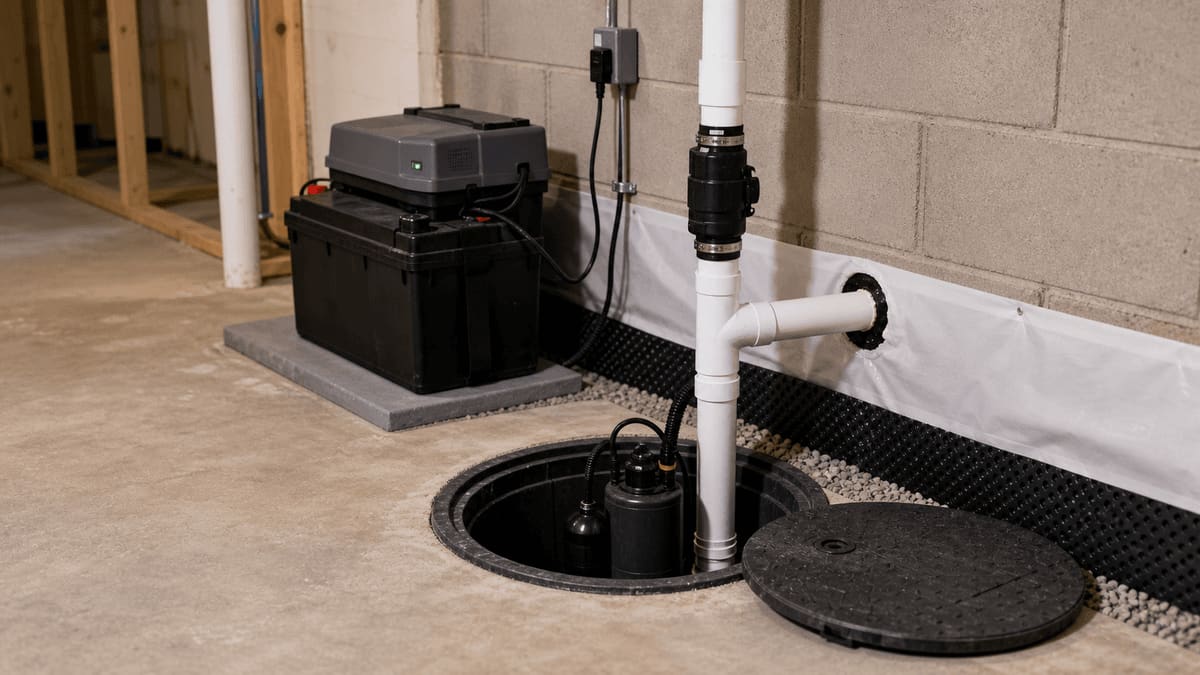
Pedestal vs submersible vs backup
The pump itself is a modest part of the bill, but the type sets reliability:
- Pedestal pump ($117–$200) — motor sits above the basin. Cheapest, easiest to service, but louder and lower capacity. Fine for occasional, light water.
- Submersible pump ($235–$400) — sits in the basin underwater. Quieter, handles more water and some debris, longer-lived. The default for a finished basement.
- Premium submersible ($470–$800) — cast-iron, higher horsepower for high water tables.
Why backup is the part that matters
A sump pump works hardest during heavy storms — which is exactly when the power tends to fail. A primary pump with no backup is one outage away from a flooded basement at the worst possible moment. Two ways to cover it: a battery backup ($352–$600) that keeps pumping through an outage, or a water-powered backup ($235–$400) that runs off municipal water pressure with no battery to maintain. For a finished basement, the backup isn't an upgrade — it's the point.
Swap vs new install
If you already have a basin, a like-for-like replacement is the cheapest path — $150–$500 in DIY parts, or $2,300–$4,000 with a pro for the pump, check valve, and discharge connection. A new install is a different job: cutting the concrete floor and digging a basin ($882–$1,500), routing discharge to daylight ($470–$800), and running a dedicated electrical circuit ($235–$400). At the top end, a sump is one piece of a full interior-drainage waterproofing system ($5,000–$15,000+).
Frequently asked questions
How much does a sump pump cost in 2026?
A like-for-like swap runs $2,300-$4,000 with the existing basin and no backup. Adding a battery backup to that same swap brings it to $2,800-$4,800 — about $450-$800 more, installed. The calculator’s "with battery" option also upgrades to a premium pump and adds frost protection, which comes to $3,300-$5,700. A water-powered backup instead brings the swap to $2,600-$4,500. A new install that cuts concrete and digs a basin, battery backup included, runs $5,400-$9,300.
Pedestal vs submersible?
Pedestal pumps cost less ($75-$200) but motor sits above water and runs noisier. Submersible pumps ($100-$400) sit in the basin, run quieter, and last longer. Most modern installs are submersible.
Do I need a battery backup?
Highly recommended. Power outages often coincide with the heavy storms when a sump pump is needed most. Installed, a battery backup adds about $450-$800 to a pump swap, and a water-powered backup, which runs on municipal water pressure instead of a battery, about $300-$500. How long a battery lasts depends on its capacity and how often the pump cycles: hours in a heavy storm, longer in light inflow.
How long do they last?
10 years typical for the pump. Float switches fail more often (3-5 yr). Replace before failure rather than after the basement floods.
Can I DIY?
Like-for-like swap = yes for most homeowners (1-2 hr work). New install with concrete cutting = pro recommended.
How much does it cost to replace a sump pump?
A like-for-like swap is $150-$500 in DIY parts or $2,300-$4,000 with a pro. With a battery backup added, the same pro swap comes to $2,800-$4,800. A brand-new install that requires cutting concrete and digging a basin runs $5,400-$9,300, and that figure already includes a battery backup.
Do I need a battery backup sump pump?
If you have a finished basement or live where storms knock out power, yes - the pump runs hardest exactly when the grid fails. Installed, a battery backup adds about $450-$800 to a swap and a water-powered backup about $300-$500; the backup units themselves are roughly $350-$600 and $235-$400 before installation and markup.
Submersible or pedestal sump pump - which is better?
Submersible pumps ($235-$400) sit in the basin, run quieter, and handle more water - the right pick for a finished basement. Pedestal pumps ($117-$200) are cheaper and easier to service but louder and lower capacity.