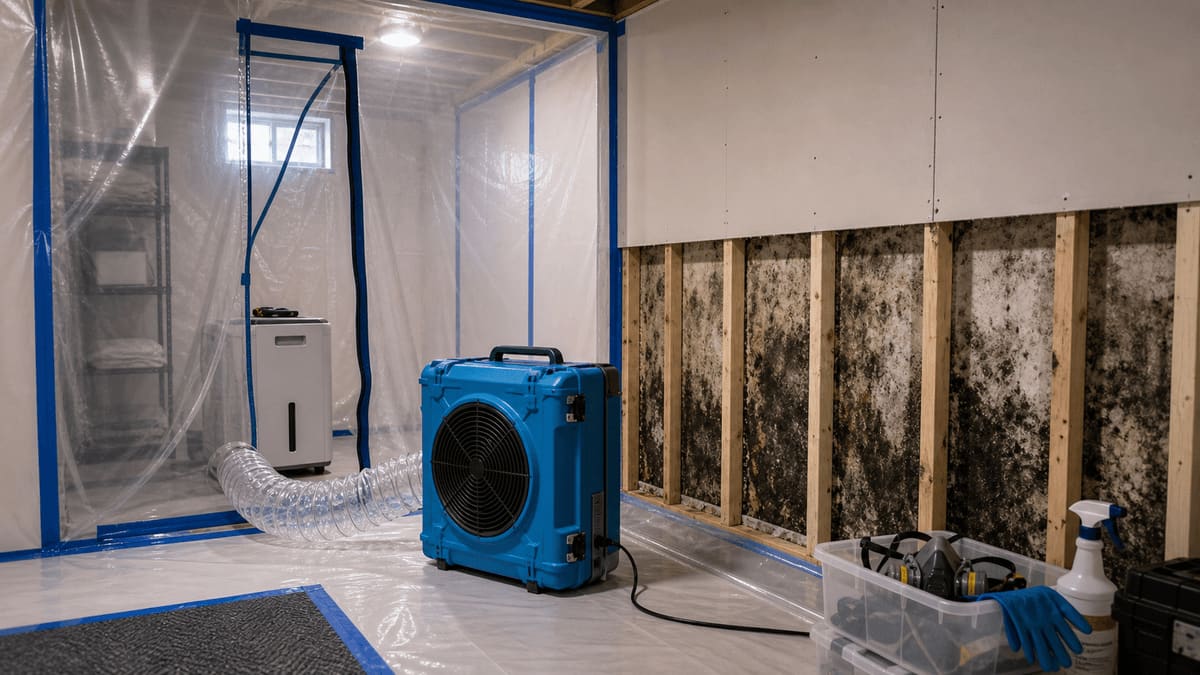
Cost tracks the affected area and the containment level the job requires — bigger jobs cost less per square foot but far more in total:
| Scope | Area | Level | Typical cost |
|---|
| Small (bathroom) | ~20 sq ft | L1 | $2,000 – $3,400 |
| Flooded room | ~100 sq ft | L2 | $4,600 – $8,000 |
| Basement-wide | ~400 sq ft | L3 | $5,000 – $12,000 |
| Whole-house / HVAC | 1,000+ sq ft | L4 | $1,500 – $98,300+ |
Per square foot, remediation runs about $12–$22 for small isolated work up to $45–$80 for extensive or HVAC-involved jobs.
What containment level do you need?
The "level" is the industry shorthand that sets the per-foot rate, based on area and how aggressively the mold must be sealed off:
- L1 — small, isolated patches (under ~10 sq ft); minimal containment.
- L2 — mid-size; sealed containment and negative air to stop spore spread.
- L3 — large areas; full containment with negative-air HEPA scrubbing.
- L4 — HVAC involvement or extensive spread; the most complex and costly.
Testing: don't skip the clearance test
Two tests bracket a proper job. A pre-remediation air sample ($250–$450) can identify species and help map spread — though the EPA notes sampling is usually unnecessary when mold is already visible, and a sample describes only the moment it was taken. A post-remediation clearance test ($350–$600) is the usual sign-off before you close the walls. There are no federal limits for airborne mold, so clearance is a professional judgement — moisture source corrected, area dry, no visible growth or musty odor — not a pass/fail threshold. The important detail: have the clearance test done by an independent tester, not the company that did the removal — a remediator grading its own work is a conflict of interest. During the job, HEPA air scrubbers ($75–$130/day) keep spores from migrating.
FAQ
How much does mold remediation cost in 2026?
A small bathroom (20 sf, L1) runs $2,000-$3,400. A flooded bedroom (100 sf, L2) $4,600-$8,000. Basement-wide (400 sf, L3) $5,000-$12,000. Whole-house (>1000 sf, L4) $1,500-$98,300+.
Should I DIY mold removal?
EPA guidelines say under 10 sq ft is generally DIY-safe with proper PPE. Anything larger, or any HVAC involvement, should be handled by an IICRC-certified remediator with containment and air-scrubbing.
Will insurance cover mold remediation?
Most homeowner policies cover mold from sudden, accidental water damage (burst pipe, storm) but exclude slow-leak / poor-maintenance mold. Document timeline and source carefully.
How much does mold remediation cost per square foot?
Roughly $12-$22 per sq ft for small isolated (L1) work, rising to $28-$48 for large containment (L3) and $45-$80 for extensive or HVAC-involved (L4) jobs. Bigger jobs cost less per foot but more in total.
What does mold remediation include?
Sealed containment, negative-air HEPA scrubbing, removal and bagging of affected drywall and carpet, disposal, surface treatment, and a clearance test. A pre-remediation air sample and post-remediation clearance test bracket the work.
Should I get an independent mold clearance test?
Yes. A post-remediation clearance test ($350-$600) is how most jobs are signed off, and having an independent tester do it - not the remediation company grading its own work - removes the conflict of interest.
More questions
Do I have to find the water source first?
Yes — it is the whole job. Mold is a symptom of a moisture problem, and per the IICRC S520 standard the underlying leak, condensation, or humidity has to be corrected or the mold regrows in the same spot within weeks. A remediation that cleans the surface but ignores the leaking supply line, roof, or grading is money spent to buy a few months.
Can I clean mold myself, or do I need a pro?
A small patch of surface mold on non-porous material — under roughly 10 sq ft, per EPA guidance — can often be cleaned by the homeowner with proper protection. Beyond that, or any mold in the HVAC system, from sewage/black-water, or hidden inside wall cavities, is professional work. This is not a rented-tool DIY: it requires containment and negative-air control most homeowners can't set up, and disturbing a large colony without it spreads spores through the house.
What is containment and negative air?
Before demolition, remediators seal the work area with plastic sheeting and run a HEPA-filtered negative-air machine so the room is at lower pressure than the rest of the house. That keeps disturbed spores from migrating into clean rooms during removal. Affected porous materials — drywall, insulation, carpet — are typically cut out and bagged inside the containment, then surfaces are HEPA-vacuumed and wiped.
Why do you need a separate clearance test?
Because the company that did the work should not be the only one grading it. Best practice is an independent indoor-environmental professional performing post-remediation verification — a visual inspection plus air or surface sampling — to verify the moisture source is corrected, the area is dry, and no visible growth or musty odor remains before the containment comes down and walls are rebuilt. Keep that clearance report; it matters at resale and for insurance.
Do we need to leave the house during remediation?
Often for the active removal phase, especially anyone with asthma, allergies, or a compromised immune system, and always if the affected area is large or involves the HVAC. Workers wear respirators and protective suits for a reason; occupants shouldn't be in or adjacent to an open containment. Small, localized jobs may not require relocation — the remediator's protocol should state it.
Will bleach or fogging fix it?
Not on its own, and not on porous material. Spraying bleach or an antimicrobial fog onto moldy drywall discolors the surface but leaves the roots and the moisture behind, and the pros generally advise against relying on it. Physical removal of the contaminated material plus correcting the water source is what actually resolves it; biocides are a supplement, not the method.