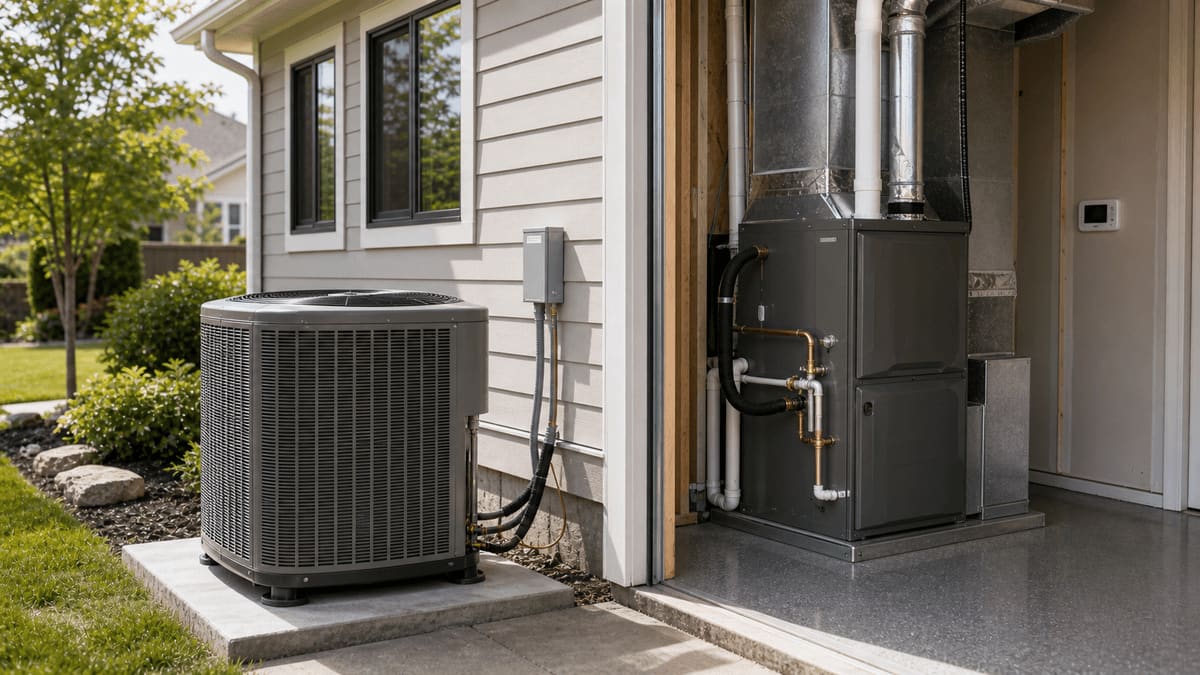
What size system does your house need?
Tonnage — cooling capacity, where 1 ton = 12,000 BTU/hr — is the first driver of cost. The planning rule of thumb is 1 ton per 600 sq ft in mild climates and 1 ton per 400–500 sq ft in hot or humid ones:
| Home size | Mild climate | Hot / humid climate |
|---|
| 1,000 – 1,200 sq ft | 2 ton | 2.5 – 3 ton |
| 1,500 – 1,800 sq ft | 2.5 – 3 ton | 3.5 – 4 ton |
| 2,000 – 2,400 sq ft | 3.5 – 4 ton | 4.5 – 5 ton |
| 2,500 – 3,000 sq ft | 4 – 5 ton | 5+ ton / two systems |
The rule of thumb is for budgeting only. Insulation, windows, ceiling height, and duct condition swing the real load — which is why a proper Manual J load calculation should anchor any quote. An oversized system short-cycles, dehumidifies poorly, and wears out early; it is the most common and most expensive sizing mistake.
Heat pump, or AC plus furnace?
The configuration table above shows the trade: a mid-tier 3-ton AC + gas furnace combo runs $9,300–$16,600 installed, while a 4-ton high-efficiency heat pump runs $9,000–$18,000. The heat pump replaces both machines — it heats and cools with one outdoor unit — and modern cold-climate models hold capacity well below freezing, which made them viable far north of their old territory.
The operating-cost math hinges on local utility prices: where electricity is cheap relative to natural gas, heat pumps win clearly; where gas is cheap, a high-AFUE furnace can still be the lower-bill choice for heating-dominated climates. Note that the federal 25C credit that subsidized high-efficiency heat pumps applied to equipment placed in service on or before December 31, 2025 — 2026 installs generally do not qualify, though state and utility rebate programs (Mass Save, NYSERDA, TECH Clean California) continue independently.
A practical middle path when a working furnace is staying: pair a heat-pump-capable condenser with the existing furnace as a dual-fuel system, letting the heat pump carry mild weather and the furnace take the coldest hours.
Ductwork: the variable nobody quotes up front
Equipment gets the brochure, but duct condition decides whether you feel the upgrade. Leaky, crushed, or undersized ducts waste a meaningful share of every conditioned air dollar and starve far rooms regardless of how efficient the new unit is. Full duct replacement adds $3,000–$8,000 and one to two days (per the configuration table above); sealing and re-balancing an intact system costs far less.
Before signing a replacement quote, ask for a static-pressure reading and a duct-leakage estimate. A contractor who tests is bidding your house; one who doesn't is bidding a brochure.
Frequently asked questions
How much does HVAC replacement cost in 2026?
3-ton AC + furnace combo (mid efficiency, existing ducts): $9,300-$16,600 installed. 4-ton high-efficiency heat pump (incl. 25% duct replacement): $13,600-$23,900 (the federal Section 25C credit applied only to systems placed in service on or before December 31, 2025). 3-zone ductless mini-split: $11,000-$17,800 - in line with our dedicated mini-split calculator. Tonnage, SEER2/AFUE/HSPF efficiency tier, and duct replacement % drive the spread.
What tonnage do I need?
Rule of thumb: 1 ton per 600 sf in mild climates, 1 ton per 400-500 sf in hot/humid climates. A 1500-1800 sf home typically needs 3 tons. Manual J load calculation is the proper way — your contractor should run one for any new install.
Are high-efficiency systems eligible for the IRA tax credit?
High-efficiency heat pumps and central AC units qualified for the federal Section 25C Energy Efficient Home Improvement credit for property placed in service on or before December 31, 2025. Projects placed in service in 2026 generally do not qualify under current IRS guidance — verify on IRS Form 5695 before relying on it. State and utility rebates (Mass Save, NYSERDA, TECH Clean California) may still apply — check program-specific equipment lists.
SEER2 / AFUE / HSPF tiers?
Basic: 14-15 SEER2 / 80 AFUE / 8 HSPF. Mid: 16-17 / 90 / 9. High: 18+ / 95+ / 10+ — the Section 25C credit applied through December 31, 2025; 2026 installs generally do not qualify.
Tax credits?
Federal Section 25C applied to qualifying systems placed in service on or before December 31, 2025; projects placed in service in 2026 generally do not qualify under current IRS guidance. Verify on IRS Form 5695. State and utility rebates may still apply.
DIY vs pro?
Refrigerant work requires EPA Section 608 cert. Only DIY-realistic option is mini-split kits with pre-charged line-sets. Everything else is pro work.
How much is a new HVAC system for a 2,000 sq ft house?
A 2,000 sq ft home typically needs 3.5-4 tons of capacity. Plan on the upper half of the 3-ton combo range - roughly $13,000-$16,600 for a mid-tier AC + furnace with existing ducts - or $9,000-$18,000 for a 4-ton high-efficiency heat pump. Duct replacement, if needed, adds $3,000-$8,000.
Should I replace the AC and furnace at the same time?
If both are past about 10 years, usually yes: the blower in the furnace drives the AC airflow, matched coils and air handlers perform as rated, you pay one mobilization instead of two, and a single-system warranty avoids finger-pointing between vintages. Replacing only the failed half of an old pair often costs more over the following five years.
How long does an HVAC system last?
Planning figures: gas furnaces 15-20 years, central AC 12-15, heat pumps 10-15 (they run year-round), mini-splits 15-20. Coastal salt air and poor maintenance shorten everything; annual service and clean filters stretch it.