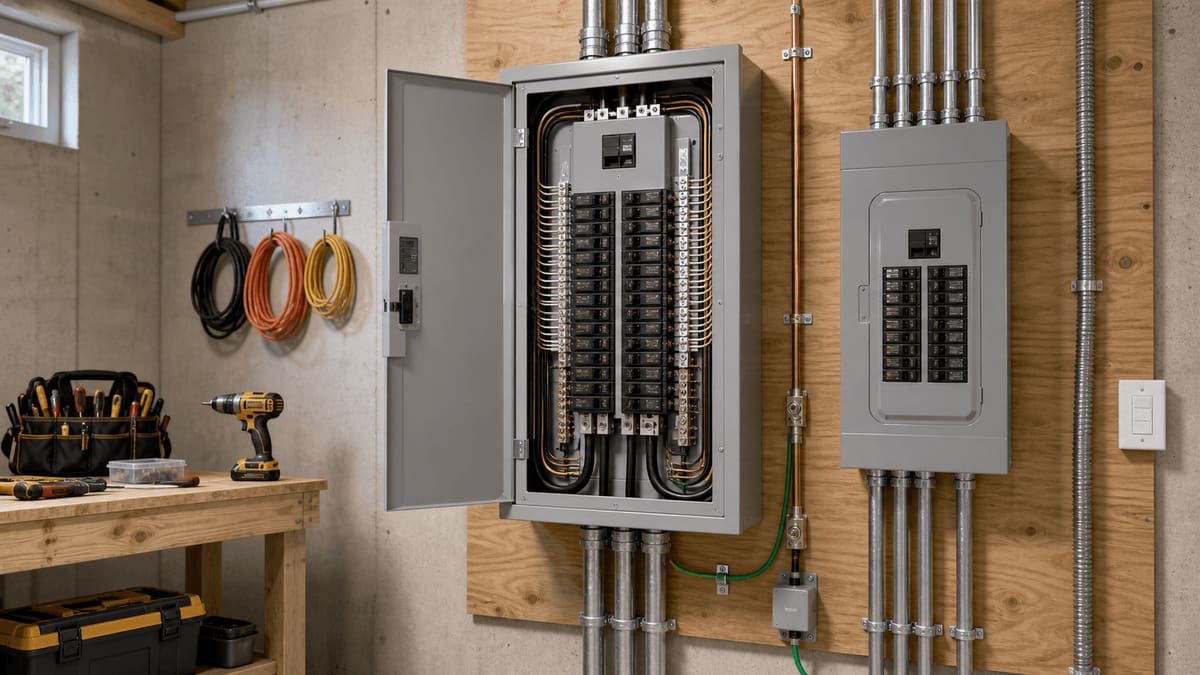
Do you actually need a panel upgrade?
Clear signals it's time: breakers that trip regularly, a fuse box or a known-hazard panel (Federal Pacific, Zinsco), no open slots for new circuits, scorch marks or a warm panel, or a major new load on the horizon — an EV charger, heat pump, induction range, or hot tub. Older homes on 100-amp service frequently can't carry today's all-electric additions, which is what pushes most upgrades to 200 amps.
100A vs 200A vs 400A — sizing the service
- 100 amp — older and smaller homes with gas heat/cooking. Increasingly tight for modern electric loads.
- 200 amp — the modern standard. A like-for-like 200A swap runs $3,700–$6,800; upgrading 100A→200A service is $7,300–$12,800. Right for most homes adding an EV charger or heat pump.
- 400 amp — large homes, heavy electric heat, multiple EVs, or a workshop. $8,200–$14,900.
Need more circuits but not more service capacity? A sub-panel ($2,800–$5,100) adds slots without a full service upgrade.
The costs people don't see coming
A panel upgrade is rarely just the panel. Depending on the home, the quote can include utility coordination to disconnect/reconnect the service ($470–$800), a new meter base ($294–$500), service-entrance cable ($470–$800), a grounding/bonding upgrade to current code ($235–$400), and the permit + inspection. Old homes are where it climbs — removing knob-and-tube wiring alongside the upgrade can add $1,470–$2,500 and turn a one-day job into a one-to-two-week project. This is licensed-electrician work end to end; it's not a DIY panel.
Frequently asked questions
How much does a panel upgrade cost in 2026?
Like-for-like 200A panel swap runs $3,700-$6,800 in 2026. 100A to 200A service upgrade (with new mast and meter): $7,300-$12,800. Upgrade to 400A for EV + electrification: $8,200-$14,900. Adding a 100A sub-panel: $2,800-$5,100.
Why upgrade to 200A or 400A?
Modern homes with EV chargers (40-80A), heat pumps (30-60A), induction ranges (40-50A), and solar/battery systems quickly outgrow 100A service. 200A is today's default; 400A is becoming standard for all-electric homes with EV + heat pump + battery.
Do I need a permit to replace an electrical panel?
Yes — main panel work always requires a permit and licensed electrician in nearly every US jurisdiction. Service-side work (mast, meter base) requires utility coordination too. Permit pull is a $150-$1,500 line item.
How long does it take?
1 day for swap. 1-2 days for service upgrade. 2-3 days for 400A. Power off 4-8 hours during work.
What does current electrical code add to a panel job?
It depends on the NEC edition your jurisdiction has adopted and its local amendments. Editions from 2020 on require a whole-home surge protective device on the dwelling service (230.67). AFCI protection (210.12) covers many dwelling circuits, bedrooms among them. GFCI protection (210.8) is a different device for locations such as bathrooms, kitchens, garages, basements and outdoors — it is not the bedroom requirement. Tamper-resistant receptacles apply to new and replaced outlets. Your electrician and the inspector settle exactly which circuits need which.
How much does it cost to upgrade to a 200 amp panel?
A like-for-like 200A panel swap runs $3,700-$6,800. Upgrading 100-amp service up to 200 amps is $7,300-$12,800 because it adds utility coordination, a new meter base, and service-entrance work. Going to 400 amps is $8,200-$14,900.
Do I need a 200 amp panel for an EV charger or heat pump?
Often, yes. Many older 100-amp panels do not have spare capacity for a Level 2 EV charger or a heat pump, so an upgrade to 200 amps is required first. An electrician can run a load calculation to confirm before you commit.
Why is a panel upgrade so expensive?
The panel itself is a fraction of it. The cost is utility coordination, a new meter base and service-entrance cable, grounding brought to current code, the permit and inspection, and - in older homes - possible knob-and-tube removal ($1,470-$2,500).