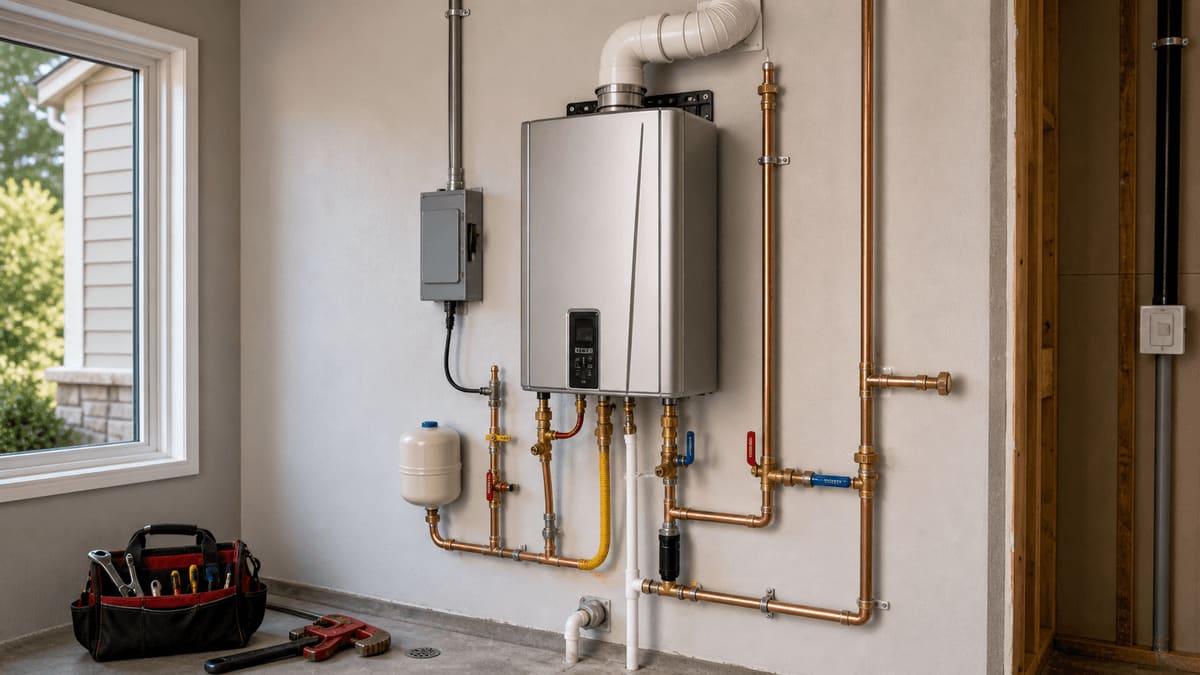
Tankless cost: gas vs electric
A whole-house tankless swap is priced by fuel type and capacity:
| Type | Installed | Notes |
|---|
| Gas tankless | $4,500 – $7,500 | Higher flow; whole-house in any climate |
| Electric tankless | $3,900 – $6,600 | Simpler install where power allows |
| Condensing (premium) | +$500 – $1,500 | Higher efficiency, PVC venting |
Add-ons move the total: a gas-line upsize ($350–$1,200) or a new electrical circuit ($700–$2,500).
Weighing tankless against a standard tank or a heat pump? See our tankless vs tank vs heat-pump cost comparison for the install, lifespan, and 10-year running-cost math.
Why installation adds so much
The unit is often only half the bill, because a tankless heater demands far more from your fuel supply than the tank it replaces. Gas units fire at very high BTU, so they frequently need a gas-line upsize ($350–$1,200) and new venting (concentric direct-vent $250–$450, or sidewall PVC $350–$600). Electric whole-house units draw heavy amperage, often requiring a new 240V circuit ($700–$1,300) or even a sub-panel ($1,500–$2,500). Plus removal of the old heater and an isolation/descaler kit ($250–$450). This is why a "$1,500 unit" becomes a $4,000 install.
Sizing by flow rate, and hard water
Tankless heaters are sized by flow rate (gallons per minute) and incoming water temperature, not by tank gallons — you size to how much hot water you'll draw at once (a shower + a dishwasher, say) in your climate. Gas units (140k–199k BTU) deliver the high flow a whole house needs; electric units (18–36 kW) suit smaller homes or warm climates with higher incoming water temps. One maintenance note: hard water scales the heat exchanger, so install an isolation/descaler kit ($250–$450) and flush it annually — that's what gets you the 20+ year lifespan tankless is known for.
FAQ
How much does a tankless water heater cost in 2026?
Gas tankless installed runs $4,500-$7,500 for a typical whole-house swap. Electric whole-house $3,900-$6,600. Premium condensing units add $500-$1,500. Gas-line upsize adds $350-$1,200; new electrical circuit $700-$2,500.
Tankless vs tank?
Tankless costs 2-3x more upfront but lasts 20+ years vs tank 10-12. Energy savings are 10-30% depending on usage pattern. Best ROI for households with high or variable hot-water demand; weakest for low-use single-occupant households.
Are federal tax credits still available for a tankless water heater?
The federal Section 25C energy-efficient home improvement credit applied for property placed in service on or before December 31, 2025. Projects placed in service in 2026 generally do not qualify under current IRS guidance — verify on IRS Form 5695 and the IRS Residential Clean Energy Credit page before relying on it.
Why is tankless water heater installation so expensive?
The unit is about half the cost. Gas models usually need a gas-line upsize ($350-$1,200) and new venting; electric whole-house models need a new 240V circuit ($700-$1,300) or a sub-panel ($1,500-$2,500). Those upgrades, plus old-unit removal, drive the install price.
Gas or electric tankless water heater?
Gas (140k-199k BTU) delivers the higher flow a whole house needs in any climate but requires venting and often a gas-line upsize. Electric (18-36 kW) is a simpler install for smaller homes or warm climates - if your panel has the capacity.
What size tankless water heater do I need?
Size by flow rate (GPM) and incoming water temperature, not gallons - estimate the hot water you draw simultaneously (e.g., two showers) in your climate. Gas units cover whole-house demand; electric units suit smaller loads or warmer regions.
More questions
Do I need a permit for a tankless water heater?
Yes, essentially always for a gas unit. The install touches gas piping, dedicated venting, and often the water service, so a plumbing/mechanical permit and inspection apply. Inspectors specifically check the gas-line sizing, the vent termination clearances from windows and soffits, and the combustion-air supply — the three things a code-compliant tankless install lives or dies on.
Why does a tankless unit often need a bigger gas line?
A tank heater draws maybe 30,000–40,000 BTU/hr; a whole-house gas tankless fires at 150,000–199,000 BTU/hr on demand. That surge frequently exceeds what the existing 1/2 in. gas branch can deliver, so the installer upsizes the line to 3/4 in. (or reworks the run back toward the meter) and may need to confirm the meter and regulator can supply the load. This is one of the biggest hidden line items when converting from a tank.
What venting and drainage does it need?
Gas tankless units need their own sealed venting — category-III stainless or, on high-efficiency condensing models, PVC/CPVC — not the old atmospheric flue a tank used. Condensing units also produce acidic condensate that has to drain through a neutralizer cartridge before it reaches your plumbing, and every unit needs a source of combustion air. You cannot simply reuse the tank's vent connector.
How is a tankless heater sized — is it gallons?
No. Tankless has no storage, so it is sized by flow rate in gallons per minute at your required temperature rise, not by tank gallons. The rise is the gap between your incoming groundwater temperature and the ~120°F setpoint — a cold northern inlet (~40°F) is a much larger rise than a warm southern one (~70°F), so the same unit delivers fewer simultaneous fixtures up north. Add up the GPM of the showers and taps you want to run at once.
What maintenance does a tankless heater need?
Descaling. Hard water leaves mineral scale on the heat exchanger, which chokes flow and efficiency and can trip error codes; most manufacturers require an annual flush with a descaling solution (more often on very hard water) to keep the warranty valid. Many installs add isolation/service valves specifically to make this flush possible.
Does it also need electricity?
Yes, even gas models. The igniter, flame sensor, control board, and (on condensing units) the fan and condensate handling all run on 120V, so the unit will not fire during a power outage. Plan for a nearby receptacle; a whole-house electric tankless is a different animal that needs heavy 240V service and usually a panel upgrade.