How much does siding cost in 2026?
Re-siding runs $4 to $28 per square foot installed in 2026 depending on material. Vinyl is the budget choice; Hardie is the curb-appeal/longevity sweet spot; brick and natural stone are top of market.
| Material | Material/sf | Installed/sf | Lifespan |
|---|
| Vinyl (standard) | $1-$5 | $4-$12 | 20-30 yr |
| Engineered wood | $1.50-$5 | $5-$11 | 30-40 yr |
| Vinyl (premium / insulated) | $3.50-$8 | $6-$15 | 25-35 yr |
| Metal (steel / aluminum) | $3-$9 | $7-$15 | 40-50 yr |
| Fiber cement (Hardie) | $1.50-$5 | $7-$13 | 30-50 yr |
| Cedar lap | $3-$8 | $9-$18 | 25-40 yr |
| Stucco (3-coat / EIFS) | $1-$5 | $8-$15 | 50-80 yr |
| Cedar shake | $4-$12 | $11-$25 | 25-40 yr |
| Manufactured stone veneer | $5-$10 | $12-$22 | 50+ yr |
| Brick veneer | $5-$15 | $14-$28 | 75+ yr |
| Natural stone veneer | $12-$30 | $22-$50 | 100+ yr |
Siding cost by material
At a fixed wall area, the material you pick is the single biggest driver of a re-siding budget — though how much wall you are covering moves the total further still (see what drives project costs). Here is what each option actually costs installed, and where it makes sense.
Vinyl siding
The budget benchmark at $4–$12 per square foot installed (premium and insulated vinyl runs $6–$15). It never needs paint, installs fast, and is the best pure dollar-per-square-foot value in siding. The trade-offs are a less premium look up close and the fact that it can crack in hard freezes or warp near heat sources. Best for rentals, budget-conscious whole-house re-sides, and most tract housing.
Cedar siding (lap & shake)
Natural wood at $9–$18 per square foot installed for cedar lap and $11–$25 for hand-split cedar shake. Cedar gives a warmth and texture no synthetic matches, and it can be stained or painted. The catch is maintenance: cedar needs re-staining or sealing every 3–7 years, and it is vulnerable to rot and insects if neglected. Budget for the lifetime upkeep, not just the install.
Fiber cement siding (James Hardie)
The curb-appeal and longevity sweet spot at $7–$13 per square foot installed. Fiber cement — James Hardie is the dominant brand — lasts 30–50 years, holds paint for 10–15 years, and is fire-resistant and rot-proof. It costs roughly double vinyl and is heavier to install (which is most of the labor premium), but it is the material most likely to pay back at resale. The best all-around choice for an owner who plans to stay.
Engineered wood siding (LP SmartSide)
A middle path at $5–$11 per square foot installed. Engineered wood (LP SmartSide is the leading brand) gives a real-wood look with treated strand board that resists rot and insects better than natural cedar, at a price between vinyl and fiber cement. Lighter than Hardie, so labor is a bit cheaper. A strong value pick when you want the wood aesthetic without cedar's maintenance.
Stucco
Traditional three-coat stucco and synthetic EIFS run $8–$15 per square foot installed. Stucco is seamless, fire-resistant, and extremely long-lived (50–80 years), which is why it dominates in the Southwest. It is labor-intensive, can crack with foundation movement, and needs proper drainage detailing — bad flashing behind stucco is a common and expensive failure. Hire a specialist, not a generalist.
Brick & stone veneer
Top of market: manufactured stone veneer at $12–$22 per square foot installed, brick veneer at $14–$28, and natural stone at $22–$50+. These are effectively permanent (75–100+ year lifespans) and need almost no maintenance, but the material and the masonry labor both run high. Most homes use brick or stone as an accent (wainscot, entry, chimney) rather than full-wrap to manage the budget.
Siding cost by house size
Siding is priced on wall area, not floor area. A single-story 1,500 sq ft home typically carries 1,200–1,600 sq ft of siding; a two-story 2,000 sq ft home carries roughly 1,800–2,400 sq ft, since upper-floor walls stack on the same footprint. The table multiplies wall area by the installed ranges above — vinyl $4–$12/sq ft, fiber cement $7–$13, cedar lap $9–$18.
| Siding area | Vinyl | Fiber cement (Hardie) | Cedar lap |
|---|
| 1,000 sq ft | $4,000 – $12,000 | $7,000 – $13,000 | $9,000 – $18,000 |
| 1,500 sq ft | $6,000 – $18,000 | $10,500 – $19,500 | $13,500 – $27,000 |
| 2,000 sq ft | $8,000 – $24,000 | $2,000 – $27,200 | $18,000 – $36,000 |
| 2,500 sq ft | $10,000 – $30,000 | $17,500 – $32,500 | $22,500 – $45,000 |
| 3,000 sq ft | $12,000 – $36,000 | $21,000 – $39,000 | $27,000 – $54,000 |
Gables, dormers, and multiple corners add cutting labor; tall walls add staging. Use the calculator's inputs above to reflect your actual geometry rather than the flat-wall assumption.
Side over the old siding, or tear off?
Vinyl can sometimes be installed over old wood lap siding if the wall is flat, dry, and structurally sound — it saves the removal line item and keeps debris out of the dumpster. But going over the top hides the condition of the sheathing, traps any existing moisture problem, and usually voids the "system" warranty that requires installation over an approved water-resistive barrier.
Tear-off is the default recommendation: it exposes sheathing rot while it is still a patch-level repair, lets the crew install modern housewrap and flashing correctly, and keeps wall depth standard at windows and trim. If a contractor proposes an overlay to hit a price point, ask specifically how they will verify sheathing condition and where the new water-resistive barrier goes.
James Hardie siding: plank, board, and shake
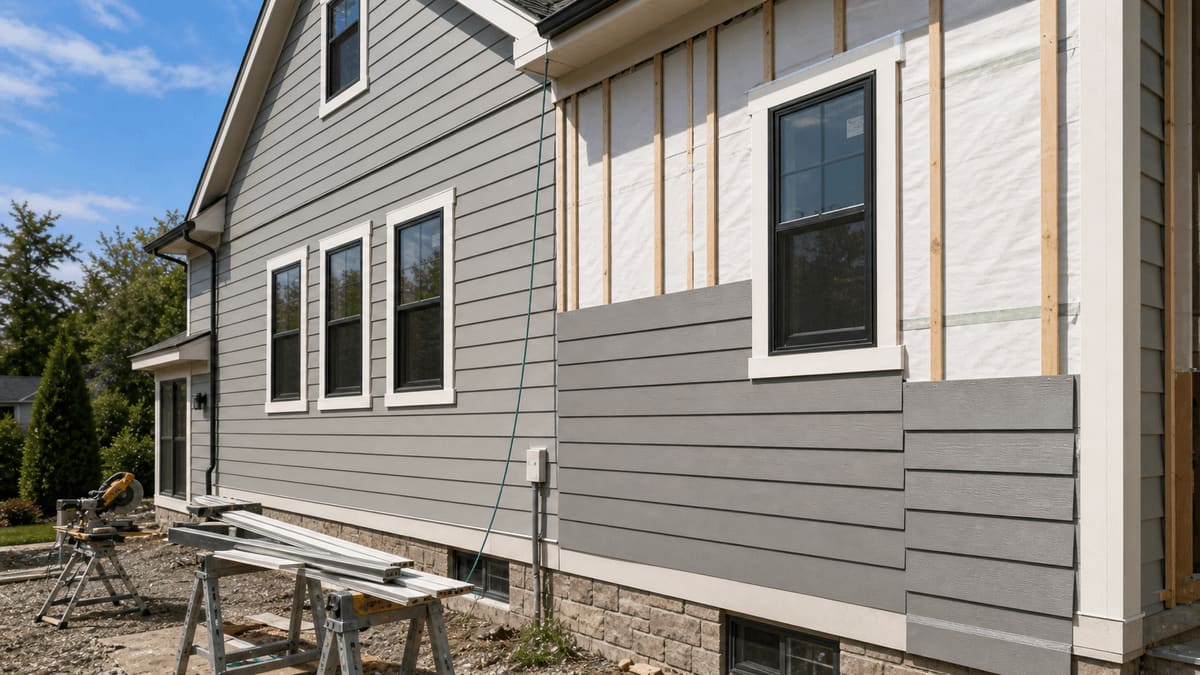
Fiber cement — James Hardie is the dominant brand — installs at $7–$13 per square foot, so 2,000 sq ft of wall area runs roughly $14,000–$26,000 at the base installed rate. A complete configured job — tear-off, house wrap, trim, soffit and fascia, and contractor markup — lands higher; see the calculator band above. It comes in three main profiles to match almost any home:
- HardiePlank lap siding — the classic horizontal clapboard look and the most-installed profile.
- HardiePanel (board) + batten — vertical panels for a modern farmhouse or board-and-batten style.
- HardieShingle — cedar-shake appearance without the rot or insect risk.
To estimate material, measure your wall square footage (length × height of each wall, minus large openings). Hardie comes either ColorPlus (baked-on factory color, 15-year finish) or primed for field painting. It costs roughly double vinyl but lasts 30–50 years, holds paint 10–15 years, and is fire- and rot-resistant — most of its labor premium is simply that the boards are heavier to cut and hang.
Frequently asked questions
How much does siding cost in 2026?
$4-$28/sf installed depending on material. Vinyl $4-$12, Hardie $7-$13, cedar $9-$25, brick $14-$28. A 2,000 sf re-side runs $8,000-$30,000+.
Is fiber cement better than vinyl?
Hardie lasts 30-50 yr vs. vinyl's 20-30, takes paint, and is fire-resistant — but costs roughly 2x installed. Vinyl is best $/sf; Hardie is curb-appeal/longevity.
Do I need to remove old siding first?
Best practice yes — tear-off lets you inspect sheathing, replace wrap, add insulation. Costs $0.50-$3/sf. Overlay saves money but hides defects.
What's the cheapest siding?
Standard vinyl at $4-$8/sf installed. Engineered wood is close. Vertical metal panels can be cheaper on simple rectangular walls.
How long does siding installation take?
2-3 weeks for a 2,000 sf home in vinyl, 3-5 weeks for Hardie or cedar. Stucco is 3-4 weeks (multi-coat cure). Brick veneer 4-8 weeks.
Why does the calculator show a price range?
Material brand, prep level (rotted sheathing, asbestos, lead paint), house complexity, and trim work all swing the total 30-60%. A range gives an honest planning estimate.
How much does it cost to side a 2,000 sq ft house?
A 2,000 sq ft two-story home typically carries 1,800-2,400 sq ft of wall area. That is roughly $7,000-$29,000 in vinyl, $27,200-$44,600 in fiber cement (Hardie), and $16,000-$43,000 in cedar lap, installed. Single-story homes of the same floor area carry less wall and cost less.
Is Hardie board worth the extra cost over vinyl?
Fiber cement costs roughly double vinyl installed ($7-$13 vs $4-$12 per sq ft) and repays it in longevity (30-50 years), fire resistance, rot-proofing, and resale perception. If you plan to sell within a few years on a budget-priced street, vinyl usually pencils out; for a long-term home, Hardie is the stronger buy.
Can you put new siding over old siding?
Sometimes - vinyl over flat, sound wood lap is the common case, and it saves removal cost. But overlays hide sheathing rot, complicate window and trim depth, and often void system warranties that require an approved water-resistive barrier underneath. Tear-off is the default recommendation.
How much does James Hardie siding cost?
HardiePlank and other fiber-cement siding runs $7-$13 per square foot installed - about $14,000-$26,000 at that base rate for 2,000 sq ft of wall area. A complete configured job (tear-off, wrap, trim, soffit and fascia, markup) runs higher. That is roughly double vinyl, repaid by a 30-50 year lifespan and fire and rot resistance.
Hardie plank vs vinyl siding - which is better?
HardiePlank fiber cement costs about double vinyl ($7-$13 vs $4-$12 per sq ft installed) but lasts 30-50 years, resists fire and rot, holds paint 10-15 years, and returns more at resale. Vinyl wins on upfront price and zero painting; Hardie wins on longevity and curb appeal.