How much does a retaining wall cost in 2026?
Retaining walls run $20 to $120+ per face square foot installed in 2026 depending on material and engineering needs.
| Material | Material/sf | Installed/sf | Lifespan |
|---|
| Timber (PT 6x6) | $10-$25 | $20-$40 | 15-25 yr |
| Segmental block | $15-$30 | $25-$50 | 40-100+ yr |
| Gabion | $20-$50 | $35-$80 | 50+ yr |
| Boulder / stone | $30-$60 | $50-$100 | 100+ yr |
| Poured concrete | $30-$80 | $50-$120 | 50+ yr |
Retaining wall cost by size
Walls are priced by the square foot of wall face (length × exposed height). Here's what common walls run in the three most popular materials, as complete projects:
| Wall | Face area | Timber | Segmental block | Poured concrete |
|---|
| 20 ft × 3 ft | 60 sq ft | $3,300 – $5,600 | $4,100 – $7,000 | $6,000 – $10,800 |
| 40 ft × 4 ft | 160 sq ft | $9,700 – $17,100 | $12,200 – $21,400 | $16,800 – $30,400 |
| 50 ft × 6 ft | 300 sq ft | n/a (over 4 ft) | $24,000 – $42,000 | $34,000 – $60,100 |
Ranges are full-project planning bands from this calculator: they include excavation, base, drainage, capstone, and (on 4+ ft walls) geogrid, engineering, and permit. That is why they run above the bare installed-per-sq-ft rates in the material table.
The 4-foot rule: when you need engineering
Most jurisdictions require an engineered design and a permit for a retaining wall over about 4 feet tall — and that height is usually measured from the bottom of the footing, so it includes the part you bury. (The calculator prices the exposed face, which is smaller.) Engineering adds roughly $1,176–$2,000. Taller walls also need geogrid soil reinforcement ($3.53–$6 per sq ft) tied back into the slope. Don't treat the 4-foot line as red tape: a wall holds back tons of saturated soil, and an under-built one fails by leaning, bulging, then collapsing — far more expensive to rebuild than to engineer right the first time.
Drainage is what actually keeps a wall standing
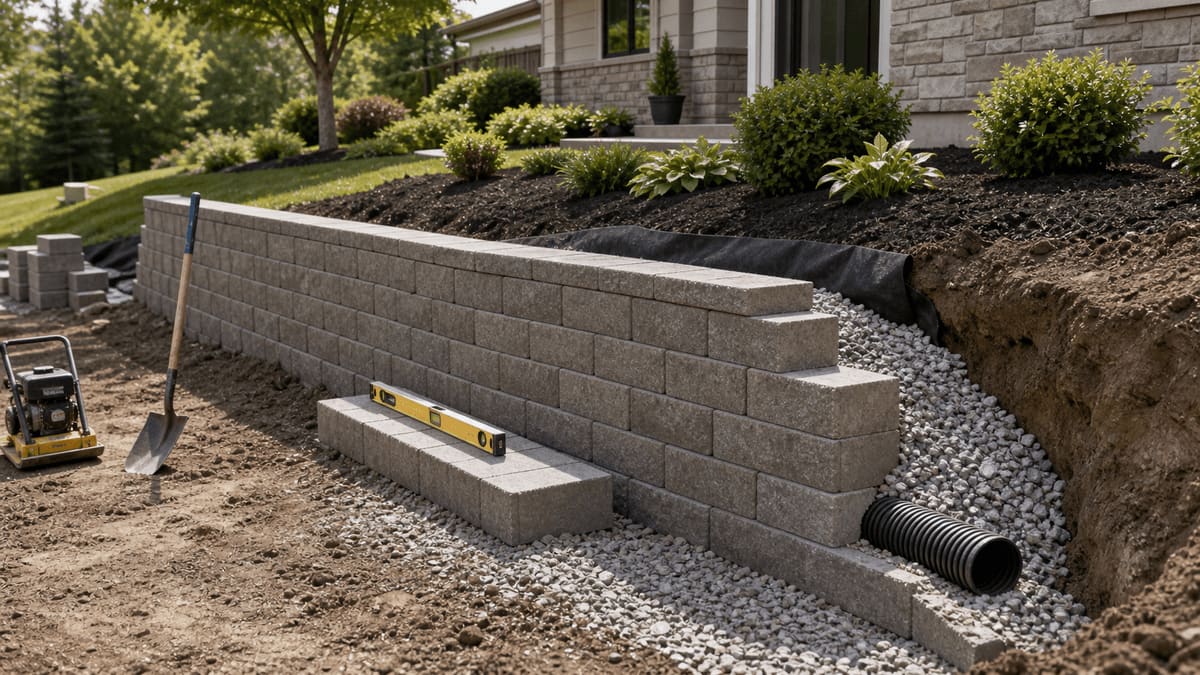
The number-one cause of retaining-wall failure isn't the wall material — it's water building up behind it (hydrostatic pressure). Every quote should include proper drainage ($4.71–$8 per sq ft): gravel backfill, a perforated drain pipe at the base, and weep holes or an outlet. A timber wall is cheapest up front ($20–$40/sq ft installed) but has the shortest life at 15–25 years; segmental block ($25–$50) lasts 40–100+ years and is the best all-around value; poured concrete and stone go further but cost more. If a bid omits drainage to hit a price, that's the corner being cut.
Frequently asked questions
How much does a retaining wall cost in 2026?
Segmental block walls run $25-$50 per face square foot installed in 2026. Timber walls $20-$40/sf. Boulder/natural stone $50-$100/sf. Engineered concrete $50-$120/sf. A typical 3 ft x 30 lf block wall (90 sf face) runs $6,100-$10,600 as a complete project with base, drainage, and cap.
Do I need a permit for a retaining wall?
It depends on your jurisdiction, and on how the height is measured. The model residential code (IRC R105.2) exempts a retaining wall only when it is no more than 4 feet tall measured from the bottom of the footing to the top of the wall — not from the ground you can see — and only when it supports no surcharge such as a driveway, a building or sloped soil above it. So a wall showing 3.5 feet above grade on a buried footing can already be over the line. Many places set their own threshold. Walls holding back a structure, a steep slope or other load need engineering at any height.
How tall can a DIY retaining wall be?
There is no safe universal height. Short gravity walls of block or timber, roughly 3 feet or less of total height on firm, well-drained soil with nothing pushing on them from above, are the range homeowners commonly build themselves. Clay, a slope above the wall, a driveway or patio near the top, or poor drainage all change that, and closely stepped walls do not get around it: a lower wall has to carry the upper one, so tiers only behave independently when they are set well apart. Past about 3 feet, or with any of those conditions, get a design with geogrid reinforcement from the block manufacturer or an engineer.
What's the lifespan?
Timber 15-25 yr. Block 40-100+ yr. Boulder/concrete 50-100+ yr.
Why is drainage critical?
Soil that cannot drain holds water, and water pressure behind a wall adds to the soil load the wall was sized for. Poor drainage is one of the most common reasons retaining walls bulge, lean or fail. A typical detail is a perforated drain pipe at the base, clean crushed stone (such as #57) behind the wall, and filter fabric to keep soil out of the stone; build to the detail the block manufacturer or engineer specifies for your wall. How much extra load, and how fast an undrained wall deteriorates, depends on the soil, rainfall and wall height — there is no fixed timeline.
How much does a retaining wall cost?
Installed, expect about $20-$40 per sq ft of wall face for timber, $25-$50 for segmental block, and $50-$120 for poured concrete. A 40 ft x 4 ft block wall (160 sq ft) runs roughly $12,200-$21,400 as a complete project including base, drainage, geogrid, engineering, and permit.
What is the cheapest retaining wall material?
Pressure-treated timber is cheapest at $20-$40 per sq ft installed, but it also has the shortest lifespan at 15-25 years. Segmental block ($25-$50) costs more up front but lasts 40-100+ years, making it the better long-term value.